Car rental companies operate in a sector where every customer interaction is an opportunity to build loyalty and generate ancillary revenue — or to lose a customer permanently. Counter staff, call centre agents, and digital support teams must combine product knowledge, insurance expertise, upselling skill, and complaint handling ability in fast-paced, high-volume environments.
The training challenge is substantial. Staff turnover is high, particularly at airport and city-centre locations. Product offerings are complex — vehicle categories, insurance options, fuel policies, cross-border rules, loyalty programmes, and seasonal promotions change frequently. And every customer interaction happens under time pressure, making confident, efficient service essential.
Traditional training methods — classroom induction, shadowing experienced colleagues, and periodic refresher workshops — cannot keep pace with the speed, scale, and complexity of the modern car rental operation. AI-powered training offers a solution that adapts to each team member, delivers practice at scale, and produces measurable commercial results.
Sub-sector Training Challenges
| Challenge | Impact | Traditional Solution Limitations |
|---|---|---|
| High counter staff turnover particularly at airport locations | Continuous onboarding investment with limited return; inconsistent customer experience | Classroom induction is expensive and time-consuming; new hires are on the counter before they are ready |
| Complex product and insurance knowledge requiring confident explanation | Mis-sold or poorly explained insurance creates complaints, disputes, and regulatory risk | Static training on insurance products does not build the confidence to explain options clearly under time pressure |
| Upselling under time pressure — upgrades, insurance, extras, fuel options | Missed ancillary revenue from staff who lack confidence or technique to upsell effectively | Upselling is taught theoretically; staff rarely practise the actual conversations before facing customers |
| Multi-location consistency across airports, city centres, and franchise partners | Customer experience varies significantly between locations, damaging brand perception | Regional training quality depends on local management; no centralised visibility of standards |
| Complaint handling for vehicle issues, billing disputes, and service failures | Poor complaint handling escalates issues, drives negative reviews, and loses customers | Complaint handling is covered in induction but not practised regularly; staff learn through painful experience |
| Regulatory compliance — insurance regulations, data protection, driving licence verification | Non-compliance creates legal exposure and financial penalties | Annual compliance training is a tick-box exercise with no verification of practical application |
Sources: BVRLA — British Vehicle Rental and Leasing Association; Gartner — Customer Service Technology
How AI Transforms Training for Car Rental
Counter Staff Excellence
Before AI: New counter staff complete a 5-7 day induction covering vehicle categories, insurance products, booking systems, and customer service basics. They are then placed on the counter alongside an experienced colleague for supervised shifts. The experience is inconsistent — some mentors are excellent, others are too busy to teach effectively.
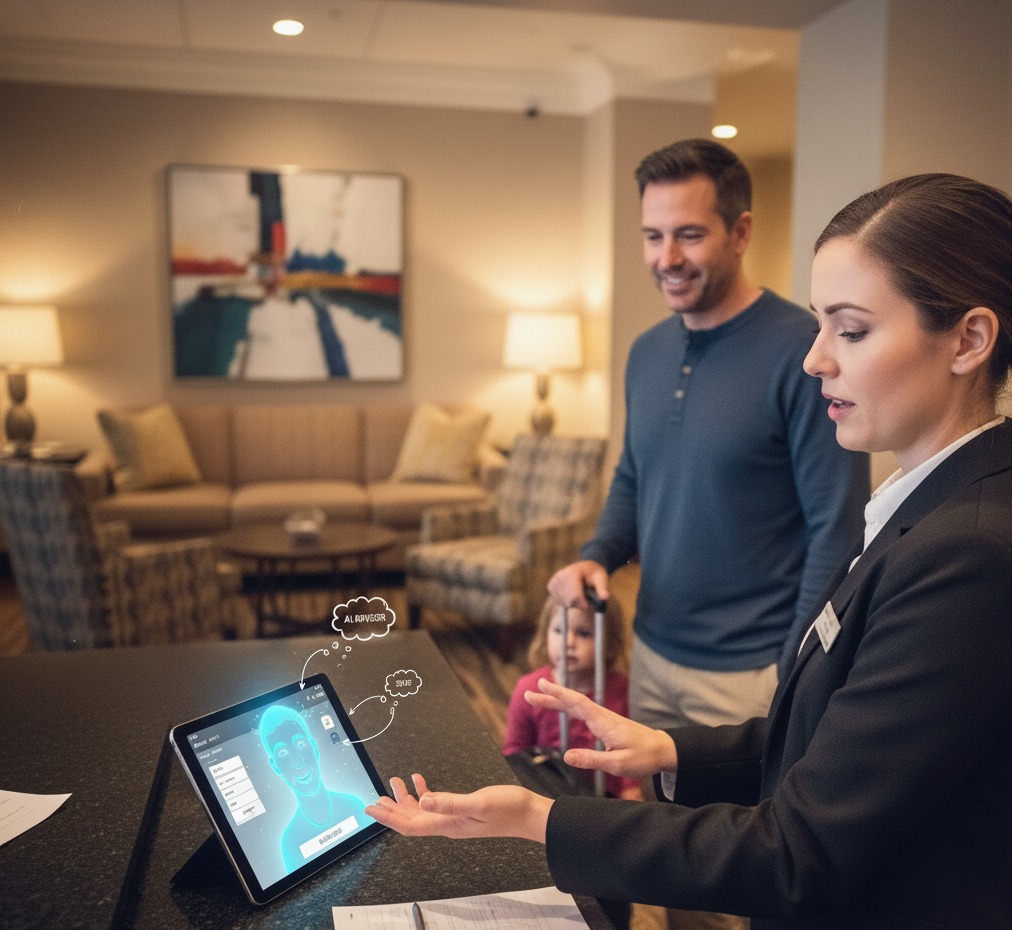
After AI: AI-powered e-learning assesses each new hire's starting knowledge and creates a personalised learning path. Someone with prior customer service experience focuses on product-specific content. Someone new to the sector receives broader foundational training. AI roleplay simulations allow counter staff to practise the complete customer interaction — greeting, reservation confirmation, upgrade recommendation, insurance explanation, extras suggestion, and handover — before they face a real customer. Coaching feedback identifies specific improvements after every simulation.
Insurance and Protection Product Selling
Before AI: Insurance training focuses on product features and compliance requirements. Staff learn what each product covers but not how to explain the value proposition in a way that drives informed customer decisions. The result: either aggressive selling that generates complaints, or tentative presentations that result in low attachment rates.
After AI: AI roleplay simulates the insurance conversation with realistic customer personas — a nervous first-time renter, a business traveller in a hurry, a family concerned about costs, a customer comparing your coverage with credit card protection. Sales coaching provides nuanced feedback on approach, language, and timing. Staff develop the confidence to present insurance products as valuable protection rather than a sales push.
Upselling Vehicle Upgrades and Extras
Before AI: Upgrade recommendations happen inconsistently. Some staff are natural sellers; most default to processing the reservation as booked. GPS units, child seats, additional drivers, and premium vehicles represent significant revenue that is left on the counter.
After AI: AI builds upselling capability through practice. Roleplay simulations present realistic scenarios — a couple arriving for a weekend break (upgrade opportunity), a business traveller with a small booking (executive vehicle pitch), a family needing extras (child seats, GPS, additional driver). Repeated practice builds the muscle memory that drives confident, natural upselling in the real interaction. Performance tracking correlates training with actual upselling revenue.
Complaint Handling and Service Recovery
Before AI: Staff learn complaint handling principles during induction and then face the real thing — an angry customer whose vehicle was not ready, a billing dispute at return, a vehicle quality issue. Learning through live complaints is expensive in terms of customer satisfaction and staff confidence.
After AI: AI simulations replicate the most common complaint scenarios. Staff practise de-escalation, apology, resolution, and service recovery techniques in a safe environment before they encounter the real situation. Scenarios are updated based on actual complaint data, ensuring staff prepare for the most frequent and damaging complaint types.
AI Training Use Cases
| Use Case | AI Capability | Business Outcome |
|---|---|---|
| New staff onboarding | Adaptive learning paths personalised by role and prior experience | 30-50% reduction in time to productive counter shifts |
| Insurance product selling | AI roleplay simulates insurance conversations with varied customer personas | 15-25% improvement in protection product attachment rates |
| Vehicle upgrade upselling | Scenario-based practice for upgrade recommendations with coaching feedback | 10-20% increase in average rental value through upgrades |
| Complaint handling | Realistic complaint simulations covering common rental disputes | Improved customer satisfaction scores; reduced complaint escalation |
| Regulatory compliance | Role-specific compliance training with continuous micro-assessments | Higher compliance adherence with reduced formal training time |
| Multi-location consistency | Centralised AI training with location-specific customisation | Consistent customer experience across all branches |
| Seasonal staff readiness | Compressed, personalised onboarding for peak-season temporary staff | Faster readiness for high-volume periods |
| Trade partner education | AI trains travel agents on your product range and booking processes | Higher trade booking volumes and fewer booking errors |
Implementation Guide
Phase 1: Pilot (Weeks 1-4)
Objective: Prove impact at a single location or small group of locations.
- Select 2-3 representative locations — ideally one airport, one city centre — with 20-40 counter staff
- Focus on one high-impact use case: insurance upselling, upgrade selling, or onboarding acceleration
- Configure the TravAI platform with your vehicle categories, insurance products, extras, and brand standards
- Establish baselines: insurance attachment rates, average rental value, customer satisfaction scores, onboarding time
- Run AI training alongside existing programmes for comparison
Phase 2: Rollout (Weeks 5-12)
Objective: Expand across all locations with optimisations from the pilot.
- Deploy AI training to all company-operated locations
- Add additional use cases: complaint handling, compliance training, sales coaching
- Extend to franchise partner locations with brand-standard training
- Integrate with your fleet management and booking systems for relevant training scenarios
- Train branch managers to use performance dashboards for evidence-based team development
- Begin replacing costly classroom training days to reduce costs
Phase 3: Optimisation (Months 4-6+)
Objective: Maximise commercial return across the network.
- Analyse which training interventions generate the highest revenue uplift per location
- Use AI data to inform staffing decisions — place highest-performing upsellers at premium locations
- Expand to train at scale across franchise networks and international operations
- Integrate training data with commercial reporting for precise ROI measurement
- Use AI insights to develop and refine your selling scripts and customer interaction guidelines
ROI Analysis
| Investment Area | Return Metrics | Expected Timeline |
|---|---|---|
| Onboarding acceleration | 30-50% reduction in time to productive counter shifts; earlier revenue contribution | Months 1-3 |
| Insurance attachment | 15-25% improvement in protection product attachment rates | Months 2-4 |
| Vehicle upgrade revenue | 10-20% increase in average rental value through trained upgrade selling | Months 2-4 |
| Customer satisfaction | 5-10% improvement in NPS or satisfaction scores through better service and complaint handling | Months 3-6 |
| Training cost reduction | 30-45% reduction in classroom training and shadowing costs | Months 2-4 |
| Multi-location consistency | Reduced variance in customer satisfaction scores between locations | Months 3-6 |
Source: McKinsey — Travel, Logistics and Infrastructure; BVRLA Industry Data
Integration with Existing Systems
Fleet management systems: AI training scenarios reflect your actual vehicle fleet — categories, specifications, and availability patterns. Counter staff practise recommendations using the vehicles they will actually offer, making training immediately applicable.
Booking and reservation platforms: Training integrates with booking data to create relevant practice scenarios. AI can identify patterns — locations where insurance attachment is lowest, rental periods where upgrade acceptance is highest — and target training accordingly.
CRM and loyalty systems: Training performance data enriches customer-facing team profiles, enabling optimal staffing at premium locations and during high-value rental periods. Loyalty programme knowledge training ensures staff can promote and explain membership benefits confidently.
Quality and compliance systems: Assessment data provides auditable evidence of compliance training completion and competence for regulatory purposes. For a deeper understanding of how AI tools go beyond basic chatbots, see AI tools in travel — not just chatbots.
HR and performance management: Training data integrates with HR systems for performance reviews, career development planning, and identifying high-potential team members.
Case Study: Scenario — National Car Rental Brand Improves Insurance Attachment
The situation: A national car rental brand with 45 UK locations is underperforming on protection product attachment. The company average is 42% — well below the 55-60% that management believes is achievable. Analysis reveals significant variance between locations (28-58%), suggesting the issue is staff capability rather than customer demand. Counter staff report feeling uncomfortable "pushing" insurance products.
The AI training approach: The company deploys TravAI across 10 pilot locations selected to represent the full performance range. All counter staff complete an AI-powered assessment of their product knowledge and selling confidence.
The key intervention is AI roleplay simulation. Staff practise the insurance conversation with AI-generated customer personas. Critically, the simulations are designed to help staff present insurance as customer protection rather than a sales target. Each customer persona has different concerns — price sensitivity, existing coverage questions, unfamiliarity with local driving conditions — requiring different approaches.
Sales coaching feedback after each simulation focuses on language, tone, and timing — helping staff find an approach that feels authentic rather than scripted. Branch managers receive performance data showing which staff members are practising, how their simulation scores are improving, and where individual coaching would add value.
The results (over 4 months):
- Pilot location insurance attachment rates increased from an average of 42% to 53%
- The lowest-performing pilot location improved from 28% to 46%
- Customer complaints about insurance selling pressure decreased by 30%
- Staff confidence in insurance conversations (self-reported) improved significantly
- Average rental value increased by 12% across pilot locations through combined insurance and upgrade improvements
- The programme was rolled out to all 45 locations based on pilot results
These patterns reflect the potential of AI-powered sales coaching across customer-facing roles.
Getting Started Checklist
- Audit current counter performance: Measure insurance attachment rates, average rental values, and customer satisfaction scores by location
- Calculate training costs: Include classroom days, shadowing shifts, management time, and the revenue impact of undertrained staff on the counter
- Identify your biggest revenue opportunity: Is it insurance attachment, upgrade selling, complaint handling, or onboarding speed?
- Establish baselines by location: Performance variance between locations indicates where training will have the greatest impact
- Select pilot locations: Choose 2-5 locations representing high, medium, and low performance for a meaningful comparison
- Prepare product content: Compile vehicle specifications, insurance product details, extras pricing, and brand interaction standards
- Brief branch managers: Position AI training as a tool that supports their revenue targets and team development
- Plan system integration: Identify booking, fleet management, and CRM systems for connection
- Define success criteria: Set specific revenue and satisfaction targets for the pilot phase
- Set a realistic timeline: Plan for a 4-week pilot, 8-week rollout, and ongoing performance optimisation
For more on how to implement AI in your business without a dedicated tech team, see implementing AI in your travel business.