For decades, travel agent training followed a predictable pattern. A supplier or L&D team would create content — usually slides, PDFs, or basic eLearning modules — and push it out to every agent in the same format, at the same pace, regardless of what each individual actually needed to learn.
That model is collapsing under the weight of its own limitations. And in its place, artificial intelligence is building something fundamentally better.
This isn't speculative futurism. AI-powered training is already being used by travel businesses across the UK and globally, and the results are measurable. The World Economic Forum's Future of Jobs Report identifies AI-augmented learning as one of the most significant workplace transformations of this decade.
Here's exactly how AI is changing what travel agent training looks like, feels like, and delivers.
From One-Size-Fits-All to Truly Personalised Learning
The central problem with traditional training is assumption. It assumes every agent starts at the same knowledge level, learns at the same pace, and needs the same content. In reality, a ten-year cruise specialist and a recently hired graduate have almost nothing in common when it comes to learning needs.
AI-powered platforms solve this by assessing each agent individually before delivering a single piece of content. Through initial assessment activities and ongoing interaction analysis, the system builds a profile of what each agent knows, what they don't, and where the most impactful knowledge gaps sit.
An experienced agent who already knows Mediterranean destinations inside out might skip straight to advanced selling techniques for that region. A newcomer might start with foundational destination knowledge. Both receive exactly what they need — nothing more, nothing less.
This isn't a minor improvement. It's the difference between a doctor prescribing the same medication to every patient regardless of symptoms (traditional training) and one who diagnoses first and treats accordingly (AI-powered training). McKinsey's research on personalised learning shows that adaptive approaches can improve learning outcomes by 30-50% compared to standardised delivery.
Conversational Learning Replaces Click-Through Modules
Traditional eLearning is essentially a digital textbook with a quiz at the end. You click "next," read a slide, click "next" again, and eventually answer some multiple-choice questions that test whether you were paying attention.
AI enables a completely different paradigm: conversational learning. Instead of passively consuming content, agents engage in a dialogue with an AI learning system that explains concepts, asks questions, adapts based on responses, and provides immediate feedback.
Think of it as the difference between reading a guidebook about Rome and having a knowledgeable friend explain the city to you over coffee, answering your specific questions and tailoring their advice to what you're interested in.
This approach works because it mirrors how humans naturally learn — through conversation, questions, and feedback loops. The University of Cambridge's Centre for the Study of Existential Risk has noted that conversational AI in education represents "the most significant pedagogical shift since the invention of the printing press."
For travel agents, this means learning about a hotel's room categories by exploring a conversation about guest preferences, not by memorising a specification table. It means understanding airline fare classes by discussing real booking scenarios, not by reading a technical document.
AI Roleplay: Practising Without Risk
Perhaps the most powerful application of AI in travel training is simulated sales practice.
Selling travel is a skill, not just a body of knowledge. You can know everything about a cruise ship and still struggle to close a booking if you can't handle price objections, build rapport, or ask the right qualification questions. Skills require practice — and traditionally, that practice has been limited to real customer conversations, which carry real consequences if things go wrong.
AI-powered roleplay changes the equation entirely. Agents can practise selling scenarios — objection handling, upselling, needs analysis, complaint resolution — in a realistic simulated environment. The AI customer behaves like a real person, with distinct preferences, concerns, and objections. After each conversation, the system provides detailed feedback on what went well and what could improve.
The volume of practice this enables is staggering. In a single afternoon, an agent can complete more simulated sales conversations than they'd encounter in a typical week of real work. And every practice conversation builds the neural pathways that underpin confident, competent selling.
The Chartered Institute of Marketing has highlighted simulation-based learning as particularly effective for developing sales and customer-facing skills, noting that it bridges the gap between theory and application that traditional training leaves open.
Real-Time Coaching During Live Conversations
Training traditionally happens before the work. You learn something, then you go and try to apply it. The gap between learning and doing creates a failure point — agents forget what they learned, or the real conversation doesn't match the training scenario.
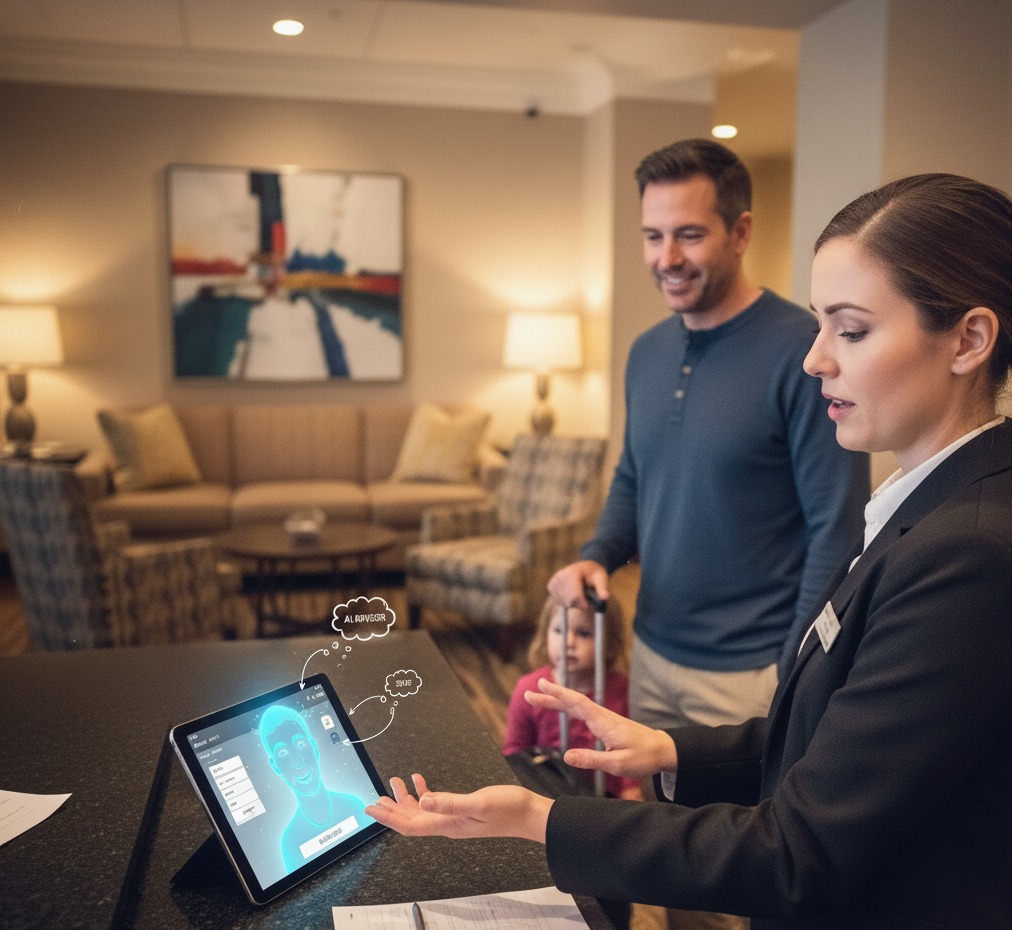
AI coaching closes that gap by providing guidance during live customer interactions. Imagine an agent on the phone with a customer enquiring about a complex multi-centre holiday. The AI listens to the conversation and provides contextual suggestions: product recommendations the agent might not have thought of, key selling points for a destination the customer has mentioned, or prompts to ask a qualification question the agent has missed.
This isn't intrusive — the agent remains in control of the conversation. The AI acts like an experienced colleague whispering helpful suggestions, not a script to be followed robotically.
The impact on confidence is particularly notable. New agents often feel anxious about calls because they know they might encounter questions they can't answer. With AI coaching available as a safety net, that anxiety reduces dramatically, which in turn improves their conversational flow and customer rapport.
Gartner's research on AI in the workplace predicts that by 2027, more than 75% of customer-facing employees will use some form of AI-assisted guidance during interactions.
Intelligent Assessment That Goes Beyond Quizzes
Traditional training assessment is binary: you either pass the quiz or you don't. The quiz tests whether you can recall facts in a controlled environment, which tells you very little about whether you can apply knowledge in a real selling situation.
AI-powered assessment is more sophisticated. It evaluates competency through:
- Adaptive questioning: Assessment difficulty adjusts based on responses, probing deeper where knowledge is strong and identifying precise gap boundaries
- Application-based testing: Rather than "Which Greek island is known for windmills?" (Mykonos), AI asks "A couple in their 60s who love history but dislike crowds are asking about Greek island options — what would you recommend and why?"
- Continuous evaluation: Instead of a single test at the end of a module, AI continuously assesses understanding through interactions, building a real-time picture of each agent's competency
- Predictive insights: By analysing patterns across thousands of agents, AI can predict which knowledge gaps are most likely to impact sales performance, allowing managers to prioritise training interventions
This means managers get a genuine picture of team capability, not just a set of quiz scores. The assessment data feeds into analytics dashboards that connect training activity to business outcomes.
Content That Updates Itself
In the travel industry, information has a short half-life. Airlines launch new routes, hotels renovate, visa requirements change, pricing shifts seasonally, and new products enter the market constantly.
Traditional training content becomes outdated almost as soon as it's published. The effort required to update slides, re-record videos, and revise quizzes means that much training content is months or even years behind reality.
AI dramatically accelerates content updates. New product information can be fed into the system and transformed into interactive training content in minutes rather than weeks. Some platforms can automatically detect when content may be outdated based on age, flag it for review, and suggest updates based on new information.
For tour operators and suppliers who need to keep their agent networks informed about product changes, this is transformative. Instead of emailing a PDF that most agents won't read, you can push an interactive, personalised update module that adapts to what each agent already knows about the product.
Breaking Down Language Barriers
The travel industry is inherently international, but training has historically been created in one language and either left untranslated or poorly localised.
AI-powered translation and localisation means training content can be delivered in 45+ languages without the expense and delay of manual translation. This matters enormously for:
- Global hotel groups training staff across multiple countries
- Cruise lines enabling agent networks across Europe, Asia, and the Americas
- DMOs promoting their destination to travel agents worldwide
- Tour operators with international distribution networks
The quality of AI translation has improved dramatically. DeepL and similar tools now produce translations that native speakers rate as near-human quality for most language pairs.
Practical Implementation: Getting Started with AI Training
If you're convinced by the potential but unsure where to start, here's a pragmatic implementation approach:
Phase 1: Replace Your Weakest Training (Month 1)
Identify the training content with the lowest completion rates or the weakest connection to business outcomes. This is usually generic product knowledge eLearning that agents click through to tick a box. Replace it with AI-powered interactive content and measure the difference in engagement and completion.
Phase 2: Add Practice Capabilities (Month 2)
Deploy AI roleplay for your most critical selling scenarios — the conversations that most directly impact revenue. Start with 5-10 scenarios and expand based on feedback.
Phase 3: Enable Real-Time Support (Month 3)
Activate AI coaching for a pilot group. Compare their sales performance against a control group over 60 days.
Phase 4: Scale Based on Data (Months 4+)
Use the data from phases 1-3 to build the business case for broader deployment. By this point, you'll have concrete evidence of impact on engagement, completion, knowledge retention, and sales performance.
What AI Cannot Do
Being honest about limitations builds trust. AI is not a replacement for:
- Human relationships: The rapport between a supplier's BDM and an agency's agents matters. AI training supplements this relationship but doesn't replace it
- Experiential knowledge: There's no substitute for having actually visited a destination. AI can teach agents about a place; experiencing it builds deeper conviction
- Strategic thinking: AI can support decision-making with data and suggestions, but strategic choices about business direction remain fundamentally human
- Empathy in crisis: When a customer's holiday goes badly wrong, human empathy and judgement are irreplaceable
The most effective approach treats AI as a tool that handles the scalable, repeatable elements of training — product knowledge, skill practice, continuous assessment — while freeing humans to focus on the relational and strategic elements where they add the most value.
The Bottom Line
AI isn't just improving travel agent training. It's redefining what effective training looks like. The businesses that adopt AI-powered learning now will have measurably better-trained, more confident, higher-performing agents than those that wait.
The technology is accessible and affordable. The evidence is compelling. And the competitive advantage for early adopters is real.
See AI-powered training in action →
This article is part of our Travel Agent Training series. Related reading: