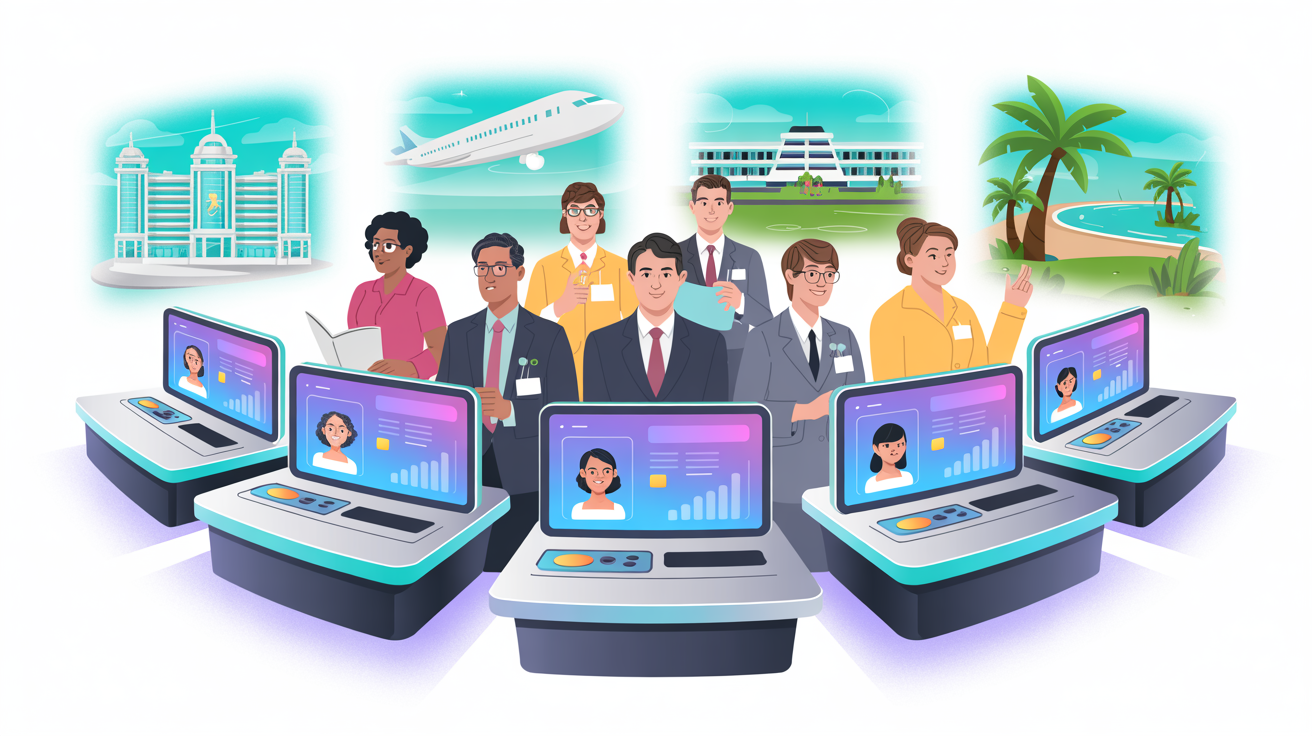
The travel industry is moving faster than at any point in its history. New destinations trend overnight on social media. Airline route networks shift quarterly. Cruise lines launch ships with features that didn't exist two years ago. Yet the way most travel businesses train their agents hasn't meaningfully changed since the early 2000s.
That disconnect costs the industry billions in lost bookings every year.
According to the World Travel & Tourism Council, global travel and tourism contributed $9.9 trillion to the global economy in 2023, with the sector employing nearly 330 million people worldwide. But research from the Association of British Travel Agents (ABTA) consistently shows that training investment per agent has declined in real terms over the past decade, even as product complexity has soared.
This guide breaks down everything you need to know about training travel agents effectively in 2026 — from choosing the right delivery method to measuring genuine return on investment.
Why Travel Agent Training Matters More Than Ever
The travel agent's role has fundamentally shifted. A decade ago, agents were primarily booking facilitators. Today, they're expected to be destination experts, sales consultants, compliance officers, and relationship managers — often simultaneously.
Three forces are driving this change:
Product complexity has exploded. A single cruise line now offers dozens of cabin categories, multiple dining packages, shore excursion bundles, beverage programmes, and Wi-Fi tiers. An agent selling Mediterranean cruises needs to understand not just the itinerary, but how each ancillary product maps to different customer profiles.
Customer expectations have risen. Travellers research extensively before speaking to an agent. Skift Research reports that the average leisure traveller consults 38 online sources before making a booking decision. When they finally contact an agent, they expect expertise that goes beyond what Google can provide.
Competition from OTAs is relentless. Online travel agencies have invested billions in user experience and personalisation. The only sustainable competitive advantage for traditional travel businesses is the quality of human advice — and that quality depends entirely on training.
The Training Methods Landscape
Not all training is created equal. Here's how the main approaches compare in the context of travel agent development.
Classroom and Workshop-Based Training
The traditional model involves gathering agents in a physical location for instructor-led sessions. Tour operators and cruise lines have historically relied on this approach for product launches, combining presentations with Q&A sessions.
Strengths:
- Face-to-face interaction builds personal relationships between suppliers and agents
- Immediate feedback and clarification
- Social learning from peer discussions
Weaknesses:
- Extremely expensive when you factor in venue hire, travel costs, staff time away from selling, and instructor fees
- Scales poorly — you can only reach a few dozen agents per session
- Research from the University of Waterloo shows that people forget approximately 70% of new information within 24 hours and 90% within a week without reinforcement
- Impossible for remote and homeworker agents to attend
The classroom model served the industry well when product catalogues were simpler and distribution networks were smaller. For most travel businesses in 2026, it cannot be the primary training mechanism.
Traditional eLearning (LMS-Based)
Learning Management Systems represented the first wave of digital training in travel. Platforms like those catalogued by Travel Weekly typically offer linear courses with slides, videos, and multiple-choice quizzes at the end.
Strengths:
- Scalable — can reach hundreds or thousands of agents simultaneously
- Self-paced learning fits around selling schedules
- Trackable completion rates and quiz scores
Weaknesses:
- Completion rates in the travel industry average just 20-30% for traditional eLearning modules
- Passive consumption — clicking through slides doesn't build selling confidence
- One-size-fits-all content doesn't adapt to individual knowledge gaps
- No practice component — agents learn facts but don't develop skills
- Content goes stale quickly as products and pricing change
Many travel businesses invested in LMS platforms during the pandemic and were disappointed by the results. The technology digitised the classroom experience but didn't fundamentally improve learning outcomes.
AI-Powered Adaptive Learning
The latest generation of travel training platforms uses artificial intelligence to personalise the learning experience for each agent. Rather than delivering the same content to everyone, AI-powered systems assess what each agent already knows, identify gaps, and adapt the training path accordingly.
Strengths:
- Completion rates above 90% because content is relevant and engaging
- Adaptive difficulty — agents aren't bored by content they've already mastered or overwhelmed by advanced material
- Interactive formats (chat-based learning, quizzes, roleplay simulations) build practical skills, not just knowledge
- Content can be updated in minutes, not weeks
- Available in 45+ languages, removing barriers for global teams
- Measurable impact on actual sales performance, not just quiz scores
Weaknesses:
- Requires an upfront technology investment (though typically far less than the annual cost of classroom training)
- Some agents may initially prefer the social aspect of in-person training
The shift from passive eLearning to AI-powered adaptive learning mirrors what happened in consumer technology. Just as Netflix replaced Blockbuster by personalising the viewing experience, AI-powered training tools are replacing generic LMS platforms by personalising the learning experience.
Blended Learning
Many forward-thinking travel businesses combine multiple methods. A common approach might use AI-powered eLearning for core product knowledge, roleplay simulations for sales skills practice, occasional in-person sessions for relationship building, and real-time AI coaching during live customer interactions.
The key is understanding which method suits which training objective — a topic we'll explore throughout this guide.
Building a Travel Agent Training Programme: Step by Step
Whether you're creating a programme from scratch or overhauling an existing one, these steps provide a proven framework.
Step 1: Audit Your Current State
Before designing training content, understand where you're starting from. This means assessing:
- Knowledge gaps: What do your agents not know that they should? Survey your team, analyse customer complaint data, and review booking patterns for missed upsell opportunities.
- Skill gaps: Knowledge and skill are different things. An agent might know that a particular cruise line offers a premium drinks package, but lack the confidence to recommend it during a sales conversation.
- Technology readiness: What systems do your agents currently use? What's their comfort level with digital tools?
- Time constraints: How much time can agents realistically dedicate to training without impacting their selling capacity?
Step 2: Define Clear Learning Objectives
Vague goals produce vague results. Instead of "improve product knowledge," define objectives like:
- Agents can articulate three unique selling points of each destination in our winter sun programme
- Agents successfully handle the "I can book it cheaper online" objection in 80% of roleplay scenarios
- New starters achieve first unassisted booking within 5 working days
Every objective should connect to a business outcome — typically increased bookings, higher average booking value, or improved customer satisfaction scores.
Step 3: Choose Your Delivery Methods
Map each learning objective to the most appropriate delivery method:
| Objective | Best Method |
|---|---|
| Product knowledge (facts, features, pricing) | AI-powered eLearning with adaptive quizzes |
| Sales skills (objection handling, upselling) | AI roleplay simulations |
| Compliance (ATOL, ABTA regulations) | Structured modules with mandatory assessments |
| Relationship building | Selective in-person workshops or webinars |
| Ongoing performance support | Real-time AI coaching during customer interactions |
Step 4: Create Engaging Content
The single biggest reason training programmes fail is boring content. Travel is inherently exciting — your training content should reflect that.
Effective travel training content:
- Uses conversational language, not corporate jargon
- Includes real scenarios agents encounter daily
- Breaks complex topics into digestible segments (5-10 minutes maximum per session)
- Incorporates visual elements — destination imagery, product comparison tables, video testimonials
- Provides immediate feedback, not end-of-module quizzes that feel like school exams
If you lack internal content creation capabilities, specialist consultancies can help you develop training materials that engage and convert.
Step 5: Launch and Iterate
Don't wait for perfection. Launch with your highest-priority content, gather feedback, and improve continuously. The advantage of digital training platforms over classroom sessions is that you can update content in real time based on what's working and what isn't.
Step 6: Measure Everything
This is where most training programmes fall short. We cover measurement in detail in the next section.
Measuring Travel Agent Training ROI
If you can't measure it, you can't improve it — and you can't justify continued investment to your leadership team.
The Metrics That Matter
Leading indicators (predict future performance):
- Training completion rates
- Assessment scores and skill progression
- Time to competency for new starters
- Engagement metrics (session frequency, voluntary participation)
Lagging indicators (confirm business impact):
- Bookings per agent (before and after training)
- Average booking value
- Conversion rate (enquiries to bookings)
- Customer satisfaction scores (NPS or CSAT)
- Agent retention rates
- Support ticket volume (particularly for trained vs untrained agents)
The Chartered Institute of Personnel and Development (CIPD) recommends the Kirkpatrick Model for evaluating training effectiveness, which measures across four levels: Reaction (did they enjoy it?), Learning (did they absorb it?), Behaviour (did they apply it?), and Results (did it impact business outcomes?).
Calculating ROI
The basic formula:
Training ROI = (Gain from Training - Cost of Training) / Cost of Training × 100
For travel businesses, "gain from training" typically means incremental revenue. If your agents' average booking value increases by £200 after training, and you have 50 agents making an average of 20 bookings per month, the monthly gain is £200,000. Against a training platform investment of a few hundred pounds per month, the ROI is transformative.
The businesses seeing the strongest results — 35% sales uplift is achievable — are those that treat training as a continuous process rather than an annual event.
Common Training Challenges (and How to Solve Them)
"Our agents don't have time for training"
This is the most common objection, and it's usually valid. Agents generate revenue by selling, not by sitting in training sessions. The solution is microlearning — breaking training into 5-minute sessions that fit between customer calls. AI-powered platforms can identify the highest-impact knowledge gaps for each agent, ensuring that every minute of training time delivers maximum value.
"We can't train remote and homeworker agents"
With the rise of homeworking models in travel, this challenge has become urgent. Cloud-based, mobile-first training platforms solve it completely. AI-powered training works on any device, anywhere, and adapts to each agent's schedule and learning pace.
"Our training content goes out of date too quickly"
In an industry where airlines change routes quarterly and hotels renovate constantly, static training content has a short shelf life. AI-powered platforms allow you to update content in minutes rather than weeks, and can automatically flag content that may need refreshing based on age or performance data.
"We can't prove training is making a difference"
Without measurement, training feels like a cost centre. Modern platforms provide analytics dashboards that track the direct connection between training activity and sales performance, making it straightforward to demonstrate ROI to stakeholders.
"Our suppliers want us to use their training, but it's all different platforms"
The proliferation of supplier-specific training portals is a real pain point for travel agencies. A centralised sales enablement platform can aggregate product knowledge from multiple suppliers into a single, consistent learning experience for your agents.
The Future of Travel Agent Training
Several trends are shaping where training is heading:
AI will become the default delivery mechanism. Just as email replaced fax machines, AI-powered adaptive learning will replace static eLearning. The International Air Transport Association (IATA) is already incorporating AI into its agent training programmes.
Training and selling will merge. The distinction between "learning" and "doing" is dissolving. Real-time AI coaching that supports agents during live customer conversations is the most powerful example of this trend.
Assessment will become continuous. Annual competency tests will give way to continuous, low-friction knowledge checks embedded into daily workflows. This approach mirrors how language learning apps like Duolingo maintain proficiency through spaced repetition.
Personalisation will become non-negotiable. Generic, one-size-fits-all training will be seen as unacceptable as generic customer service. Every agent will receive a training experience tailored to their role, experience level, and performance data.
Getting Started
If you're ready to transform your travel agent training programme, here's where to begin:
- Assess your current state — identify your biggest knowledge and skill gaps
- Set measurable objectives — define what success looks like in terms of business outcomes
- Choose the right technology — look for platforms purpose-built for travel, not generic LMS solutions
- Start small, iterate fast — launch with your highest-priority content and expand based on results
- Measure relentlessly — track both leading and lagging indicators to prove ROI
The travel businesses that invest in training today will be the ones winning bookings tomorrow. In an industry where product knowledge and sales skills are the ultimate competitive advantage, the question isn't whether you can afford to train your agents — it's whether you can afford not to.
Explore how TravAI's platform can help →
This article is part of our Travel Agent Training series. Related reading: