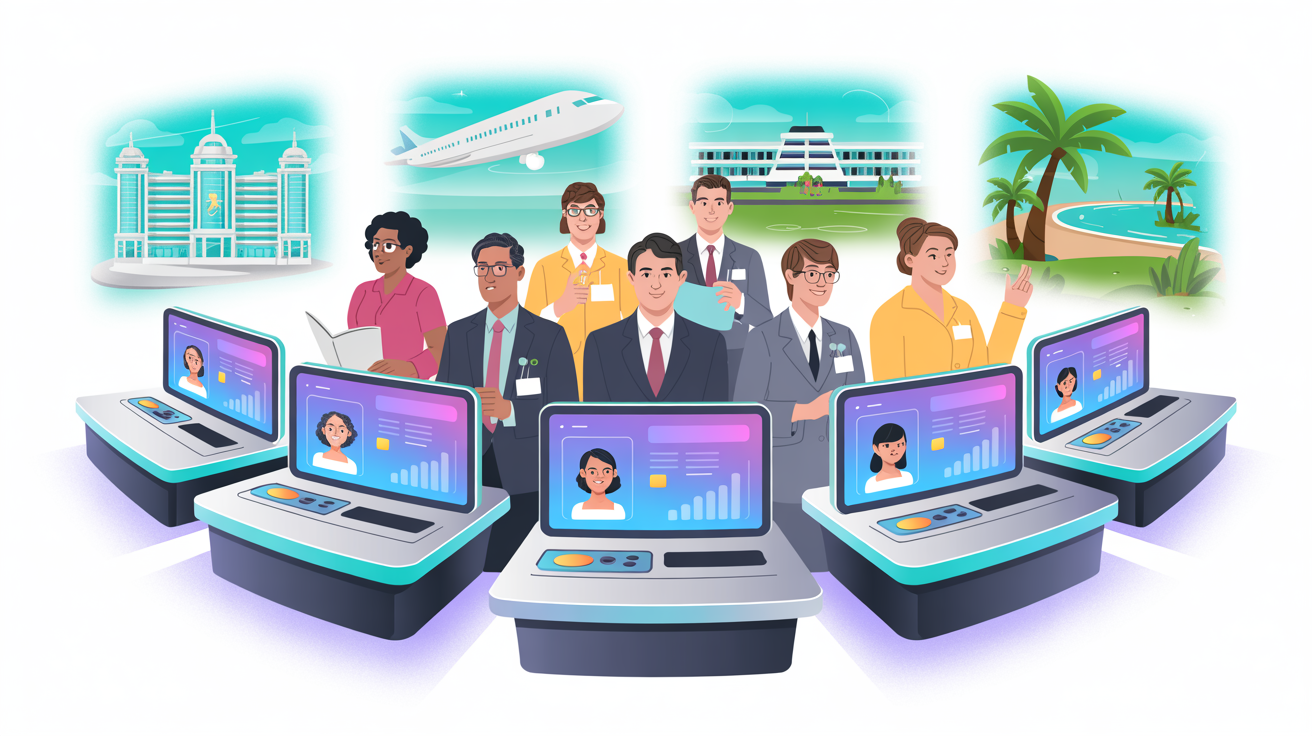
Most travel businesses take somewhere between four and twelve weeks to get a new agent to the point where they can handle a booking independently. During that time, the business is paying a salary without generating revenue, experienced agents are pulled away from selling to mentor newcomers, and the new starter is growing increasingly anxious about whether they'll ever feel competent.
It doesn't have to be this way.
The agencies achieving the fastest onboarding times — some getting new starters to first independent booking within five working days — share common principles that have nothing to do with cutting corners and everything to do with smarter programme design.
Why Traditional Onboarding Takes So Long
Before we fix the problem, let's understand it.
Traditional onboarding typically follows this pattern:
Week 1: Sit with an experienced agent and observe. Read the staff handbook. Get system logins. Weeks 2-3: Shadow calls and bookings. Start learning the product range by reading supplier brochures. Weeks 4-6: Handle simple enquiries under supervision. Attend a classroom product training day. Weeks 7-12: Gradually take on more complex bookings with decreasing supervision.
The problem isn't that this sequence is wrong — it's that it's hopelessly inefficient. New starters spend hours observing when they could be practising. They read brochures passively when they could be learning interactively. They wait for scheduled training days when they could be accessing content immediately.
Research published in the Harvard Business Review shows that organisations with strong onboarding processes improve new hire retention by 82% and productivity by over 70%. Yet the CIPD's annual survey consistently finds that onboarding is one of the most neglected areas of people management.
The Five-Day Onboarding Framework
This framework has been adapted from approaches used by high-performing travel agencies and tour operators. It assumes you have access to a modern training platform rather than relying solely on shadowing and paper-based materials.
Day 1: Foundation
Morning — Systems and Logistics (2 hours) Get the practical stuff out of the way quickly. System access, email setup, booking platform walkthroughs, team introductions. Use pre-recorded video guides for system training so the new starter can re-watch anything they need later.
Afternoon — Core Product Overview (3 hours) Instead of handing over a stack of brochures, use interactive learning modules to introduce your core product range. A well-designed module lets the new starter engage with the content actively — answering questions, exploring scenarios, and building understanding through conversation-style learning rather than passive reading.
Cover the 20% of products that generate 80% of your bookings. There's no point training someone on niche adventure tours on their first day if your bread-and-butter business is beach holidays.
Day 1 deliverable: New starter can navigate booking systems and articulate the key selling points of your top 5-10 products.
Day 2: Product Knowledge Deep Dive
Morning — Destination Knowledge (3 hours) Focus on your most popular destinations. Use AI-powered training that adapts to what the new starter already knows — some will arrive with personal travel experience that gives them a head start.
The goal isn't encyclopaedic knowledge. It's enough knowledge to have a credible conversation with a customer about these destinations.
Afternoon — Supplier Knowledge and Quizzes (2 hours) Introduce key suppliers — the hotel groups, cruise lines, tour operators, and airlines that feature most in your bookings. Use quick-fire assessments to reinforce learning and identify any areas that need more attention.
Day 2 deliverable: New starter passes a baseline knowledge assessment on core destinations and products.
Day 3: Sales Skills and Practice
Morning — Sales Fundamentals (2 hours) Cover the basics of your sales process: how an enquiry arrives, the initial conversation structure, needs analysis questions, recommendation approach, and booking procedure.
Use real examples. Play recordings of excellent customer conversations (with consent). Show what a great recommendation email looks like.
Afternoon — Roleplay Practice (3 hours) This is where AI-powered roleplay simulations transform onboarding speed. Traditional mentoring means the new starter might get to practise 2-3 conversations per day, limited by the mentor's availability and the randomness of incoming enquiries.
AI roleplay lets them practise dozens of conversations in a single afternoon. Standard scenarios for day 3:
- Customer wanting a family beach holiday in Spain
- Couple planning a honeymoon with a flexible budget
- Group booking for a milestone birthday
- Customer who's already found a price online and wants you to match it
The AI provides real-time feedback and coaching, so the new starter learns from each practice conversation without requiring constant manager oversight.
Day 3 deliverable: New starter completes at least 10 practice conversations and demonstrates competency in basic needs analysis and recommendation.
Day 4: Real Conversations (Supervised)
Morning — Buddy System Selling (full day) Pair the new starter with an experienced agent, but flip the traditional model. Instead of the new starter observing, they take the lead on customer conversations with the buddy providing backup.
For phone-based agencies, this means the new starter handles the call while the buddy listens in. For face-to-face agencies, the new starter leads the consultation while the buddy sits nearby.
The critical shift: the new starter is doing, not watching.
Between customer interactions, use any downtime for additional product knowledge modules focused on areas where the morning's conversations revealed gaps.
Day 4 deliverable: New starter handles at least 3-4 real customer conversations with buddy support.
Day 5: First Independent Bookings
Morning — Final Knowledge Check and Confidence Building (2 hours) Run a comprehensive assessment covering the week's learning. Use the results to identify remaining gaps and address them with targeted content.
Then, critically, have a confidence conversation. Many new starters have the knowledge and skill by this point but lack the self-belief to work independently. A supportive conversation with their manager about what they've achieved in four days goes a long way.
Afternoon — Independent Selling with Safety Net (3 hours) The new starter handles enquiries independently with one condition: a manager or buddy is available within earshot for any situation they can't handle. In most cases, this safety net is barely needed — but knowing it's there gives the new starter permission to try.
Day 5 deliverable: New starter makes their first independent booking.
What Makes This Work
Several principles underpin this accelerated approach:
Learn by Doing, Not Watching
Adult learning theory consistently shows that adults learn best through application, not observation. Every element of this framework prioritises practice over passive consumption.
Technology as a Force Multiplier
AI-powered tools don't replace human mentoring — they amplify it. A mentor can only work with one new starter at a time. Training technology gives every new starter access to unlimited practice, immediate feedback, and personalised learning paths.
Minimum Viable Knowledge
You don't need to know everything to make your first booking. You need enough knowledge to handle the most common customer scenarios competently. Everything else can be learned iteratively through ongoing development.
Structured with Flexibility
The framework provides structure without rigidity. If a new starter arrives with extensive destination knowledge, they can accelerate through Day 2's content and spend more time on sales practice. Adaptive learning platforms handle this automatically.
Supporting the Framework: Manager's Checklist
Before your new starter arrives:
- All system accounts created and tested
- Training platform profile set up with Day 1 content assigned
- Buddy agent briefed and scheduled
- First-week meeting schedule blocked
- Day 5 assessment configured
- Desk/workspace prepared with cheat sheets for common scenarios
During the first week:
- Daily 15-minute check-ins (morning: set the day's focus; evening: reflect on what was learned)
- Monitor training platform analytics to track progress
- Provide specific, positive feedback after each customer interaction
- Address knowledge gaps immediately with targeted content
- Celebrate the first booking
After Week One: Sustained Development
Five-day onboarding gets agents selling. But selling well — consistently, confidently, and profitably — requires ongoing investment.
The first 90 days after onboarding should include:
- Weekly: New product knowledge modules on your training platform
- Fortnightly: Sales performance review with manager using booking data
- Monthly: Advanced roleplay scenarios tackling more complex customer situations
- Quarterly: Formal progression assessment and development plan update
The Society for Human Resource Management (SHRM) recommends treating onboarding as a process that extends through at least the first year, not just the first week. The five-day framework is the foundation — continued development builds the house.
The Business Case
The maths is straightforward. If traditional onboarding takes 8 weeks and accelerated onboarding takes 1 week, you reclaim 7 weeks of productive selling time per new starter. For an agent generating £15,000 in monthly bookings, that's roughly £26,000 in additional revenue per hire.
Multiply that across all your new hires in a year, and the investment in training technology pays for itself many times over. Factor in reduced dropout rates — new starters who feel competent quickly are far less likely to leave — and the case becomes overwhelming.
This article is part of our Travel Agent Training series. Related reading: