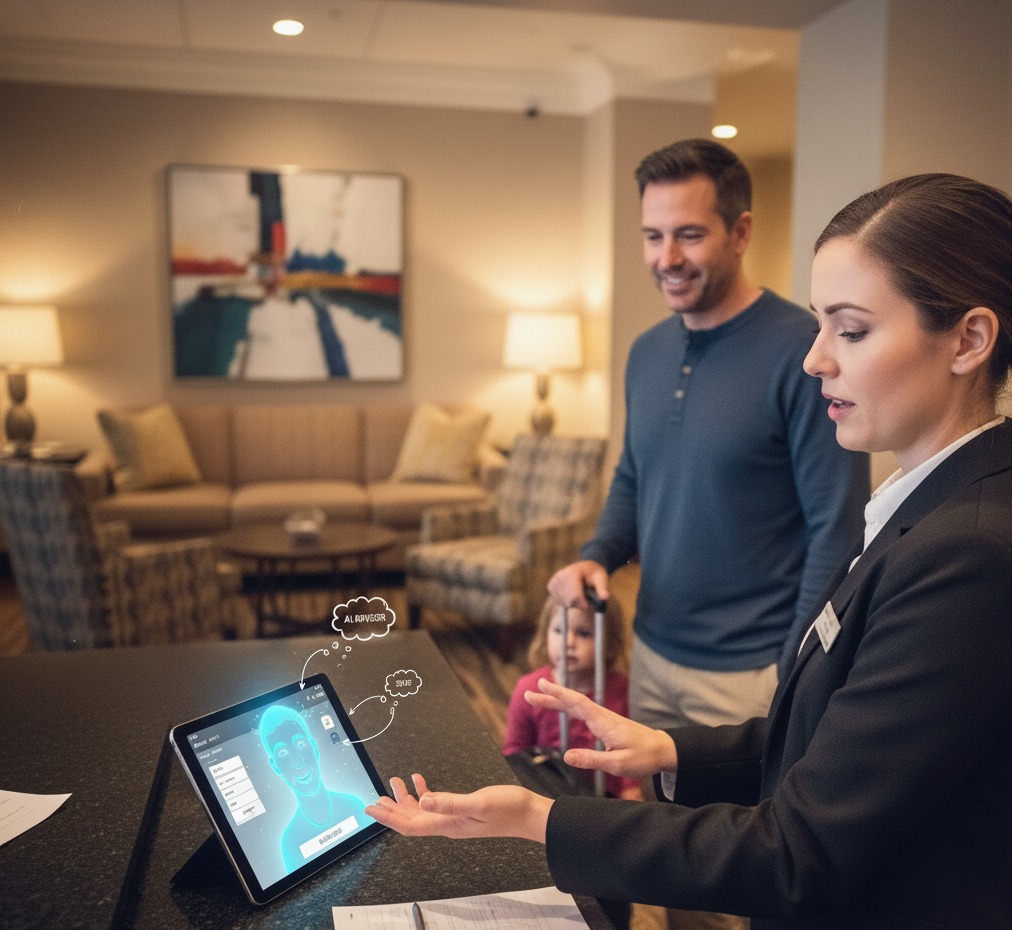
Hotel sales agents are the human layer that turns availability into revenue. Whether handling group bookings, managing corporate accounts, supporting travel trade partners, or converting direct reservation enquiries, these agents determine whether a room night is sold at the right rate to the right guest — or left empty. In an industry where a single unsold room represents permanently lost revenue, the quality of your sales team training is a direct commercial lever.
This guide provides a structured training framework for hotel sales agents, covering the competencies, programme structure, and performance benchmarks that transform new hires into confident revenue generators.
Role Overview
Core Responsibilities
A hotel sales agent is responsible for converting booking enquiries into confirmed reservations, managing relationships with key accounts (corporate, travel trade, events), proactively sourcing new business, and maximising revenue per available room through rate management and upselling. Depending on the hotel or group, the role may focus on reservations, group and events sales, corporate accounts, or travel trade partnerships.
A Typical Day
Daily activities include handling inbound reservation enquiries by phone, email, and online channels, preparing proposals for group bookings and events, managing corporate account relationships and negotiated rates, processing bookings and special requests, following up on provisional bookings and tentative holds, liaising with revenue management on rate strategy, and proactively reaching out to lapsed accounts or new prospects.
Key Challenges
The defining challenges include understanding revenue management principles and their impact on rate decisions, selling room categories and hotel experience rather than competing on price alone, managing group and events bookings with complex requirements and multiple stakeholders, maintaining service standards while meeting volume and revenue targets, and balancing direct bookings against OTA and trade partner channels.
Required Knowledge and Skills
| Skill Area | Proficiency Needed | How to Develop |
|---|---|---|
| Property knowledge | Deep — must know room categories, facilities, USPs, local area | E-learning modules per property, site tours, assessments, competitor analysis |
| Revenue management basics | Solid — must understand yield, rate fences, occupancy dynamics | Revenue management workshops, UK Hospitality resources, property-specific rate training |
| Room category selling | Strong — must articulate value differences between categories | Category comparison training, roleplay on upgrade conversations, visual aids |
| Consultative selling | Strong — must match property to guest needs, not just quote rates | Sales coaching, needs analysis workshops, roleplay scenarios |
| Group and events sales | Proficient — must manage multi-stakeholder proposals | Events sales training, proposal writing workshops, negotiation skills |
| Corporate account management | Competent — must build and maintain client relationships | Account management training, CRM proficiency, relationship-building coaching |
| PMS/booking system proficiency | Confident — Opera, Mews, or equivalent | System-specific certification, supervised practice, workflow training |
| Compliance (data protection, accessibility, H&S) | Solid — guest data and safety are non-negotiable | Mandatory compliance modules, UK Hospitality guidelines, regular refreshers |
Source: UK Hospitality; Institute of Hospitality
Competency Framework
| Competency | Beginner | Intermediate | Advanced |
|---|---|---|---|
| Property knowledge | Knows room types, main facilities, and basic local area information | Advises confidently across all room categories with experiential detail | Expert knowledge including competitor positioning, seasonal nuances, and local market intelligence |
| Rate and revenue awareness | Understands basic rate structure and seasons | Applies rate strategy in selling conversations, understands demand patterns | Collaborates with revenue management on pricing decisions, optimises channel mix |
| Room upselling | Mentions upgrade options when customer shows interest | Proactively recommends upgrades with clear value articulation | Consistently moves guests up room categories through consultative recommendation |
| Group and events | Handles basic group enquiry administration | Builds and presents group proposals independently | Manages complex multi-element events, negotiates terms, and maximises revenue |
| Corporate account management | Maintains existing account relationships reactively | Manages portfolio of accounts proactively, identifies growth opportunities | Strategically develops key accounts, drives share of wallet, and wins new corporate business |
| Guest experience selling | Describes hotel facilities factually | Sells the experience using storytelling and guest-profile matching | Creates compelling narratives that differentiate the property and command rate premium |
| Compliance | Follows data protection and safety procedures | Understands regulatory context and applies independently | Identifies risks proactively, ensures team compliance, stays current with regulations |
This framework connects to broader hotel staff training competency standards.
Training Programme Structure
| Week/Phase | Focus Area | Activities | Assessment |
|---|---|---|---|
| Week 1: Induction | Hotel, brand, systems, compliance | Property tour, brand standards immersion, PMS access and navigation, compliance modules | System navigation test, compliance assessment (90%+) |
| Week 2: Property and product knowledge | Room categories, facilities, local area, competitors | E-learning modules on property product, room category walk-throughs, competitor analysis | Property knowledge assessment — 85%+ |
| Week 3: Revenue and selling skills | Rate strategy basics, consultative selling | Revenue management introduction, sales coaching workshops, roleplay on rate conversations | Mock customer scenarios — assessed on recommendation quality and rate handling |
| Week 4: Supervised live selling | Real enquiry handling with support | Handle reservation and sales enquiries with experienced agent support, daily debriefs | Booking accuracy audit, conversion tracking, customer feedback |
| Weeks 5-8: Consolidation | Full role with coaching focus | Independent enquiry handling, weekly coaching sessions, upselling practice, group sales introduction | Weekly KPI review, roleplay assessments on upselling |
| Weeks 9-12: Specialisation | Group sales, corporate accounts, advanced skills | Group proposal workshops, corporate account management training, performance tracking | Group sales proposal exercise, account management assessment |
| Months 4-6: Performance | Revenue optimisation, strategic selling | Advanced revenue management, key account development, complex negotiation scenarios | Full competency framework assessment, revenue contribution targets |
AI Training Recommendations
Hotel sales training must balance operational efficiency with experiential selling — agents need to process bookings quickly while also communicating the property's unique character. TravAI's platform supports both:
Property knowledge at depth — AI-powered e-learning enables hotel groups to build and maintain property-specific training modules that cover room categories, facilities, local area, and seasonal highlights. When properties undergo refurbishment or launch new services, training updates deploy immediately and allow you to train at scale across multiple properties.
Rate conversation practice — Rate discussions are among the most commercially sensitive conversations in hotel sales. AI roleplay lets agents practice rate negotiation, upgrade selling, and value articulation in realistic scenarios, building confidence before they handle real guest enquiries.
Upsell coaching — Room category upselling is the most direct path to revenue growth per booking. AI sales coaching identifies agents who are consistently selling at base category and delivers targeted coaching on upgrade techniques, helping increase sales without discounting.
Consistent standards across properties — Hotel groups need consistent service and selling standards across all locations. TravAI assessments provide standardised evaluation across properties, with performance tracking that benchmarks individual and property-level results.
These capabilities are built for the hotel use case where property-specific knowledge and revenue management intersect.
Common Skill Gaps
| Skill Gap | Impact | Training Solution |
|---|---|---|
| Weak room category differentiation | Guests default to cheapest room; missed upgrade revenue | Visual-led e-learning on room categories with comparison training |
| Rate sensitivity | Agents discount too quickly or cannot justify rate | Sales coaching on value-based rate conversations, roleplay practice |
| Poor group sales proposals | Lost event and group bookings to competitors | Proposal writing workshops, group sales scenario training |
| Inconsistent upselling | Low upgrade conversion rate | Targeted upsell coaching with AI roleplay on upgrade triggers |
| Limited local area knowledge | Cannot advise on local attractions, dining, transport | Local area modules via e-learning, curated local guides |
| Revenue management disconnect | Selling at wrong rates for demand periods | Revenue awareness training, rate strategy briefings, assessments |
Onboarding Milestones
| Timeframe | Milestone | Measurable Outcome |
|---|---|---|
| End of Week 1 | Completes induction and compliance | Passes compliance assessment at 90%+, navigates PMS independently |
| End of Week 2 | Demonstrates property product knowledge | Passes property knowledge assessment at 85%+, can describe all room categories with differentiators |
| End of Week 4 | Handles supervised enquiries | Processes 10+ bookings accurately, quality audit feedback positive |
| End of Month 2 | Operates independently on reservations | Meets minimum conversion and accuracy targets, handles enquiries without escalation |
| End of Month 3 | Meets baseline revenue targets | Achieves 70% of experienced agent revenue per booking, upsell rate above 15% |
| End of Month 6 | Fully competent across role scope | Meets team average on revenue, conversion, upsell rate, and guest satisfaction |
Measuring Training Effectiveness
| KPI | What It Measures | Target |
|---|---|---|
| Revenue per available room (RevPAR) contribution | Commercial impact of sales team | Track team contribution to property RevPAR |
| Enquiry conversion rate | Selling effectiveness | 30-40% for reservation enquiries |
| Average daily rate (ADR) per booking | Rate management and upselling | Progressive increase aligned with revenue strategy |
| Upsell conversion rate | Room upgrade selling ability | 20%+ of eligible bookings upgraded |
| Group RFP win rate | Group and events sales effectiveness | Track win/loss ratio against competitors |
| Training completion | Learning programme engagement | 95%+ for mandatory modules |
| Assessment scores | Knowledge acquisition | 85%+ across property and compliance modules |
| Guest satisfaction (post-stay) | Service quality linked to sales experience | 4.5/5 or equivalent metric |
Source: UK Hospitality workforce reports; Institute of Hospitality professional standards
For additional context on hotel training strategy, see our complete hotel staff training guide and hotel sales team enablement guide.