Traditional knowledge testing in travel follows a predictable pattern: agents complete a training module, answer 10 multiple-choice questions at the end, pass with 70%, and move on. The questions never change. The pass mark rewards recognition, not recall. And within a week, 80% of what was "learned" is forgotten.
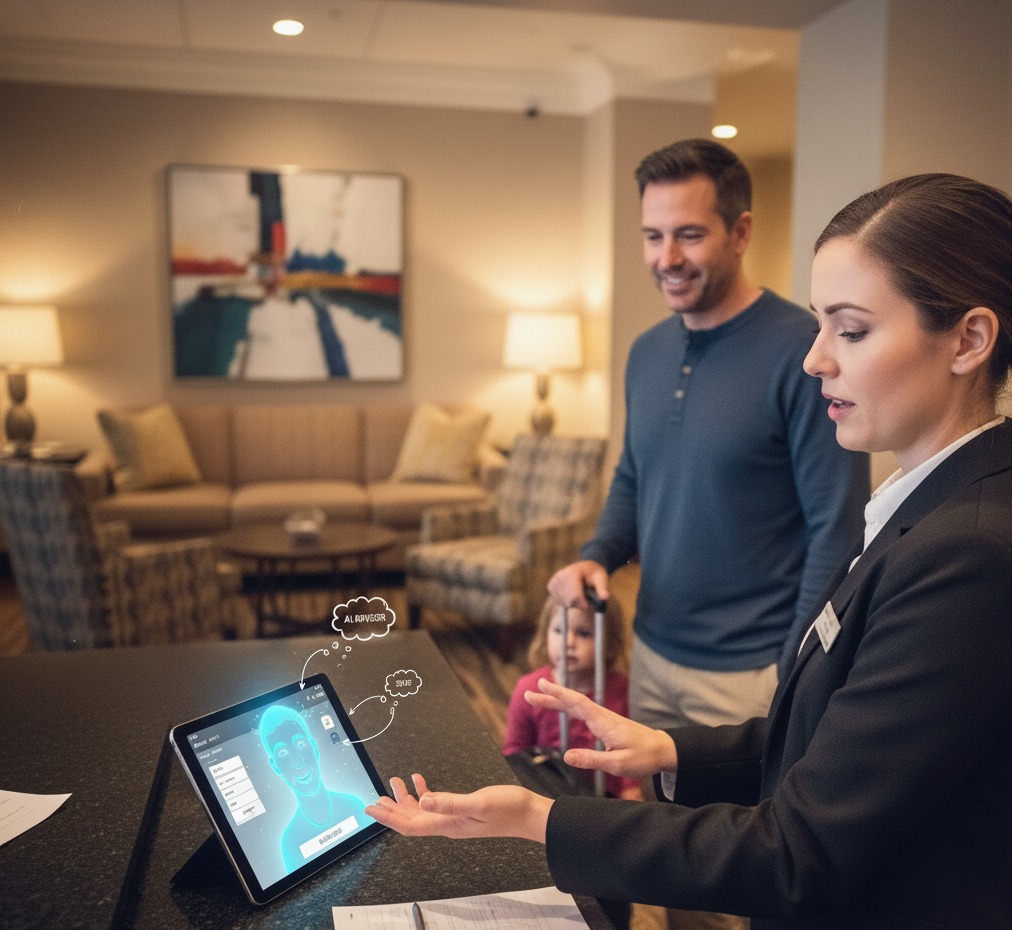
AI-powered assessments work differently. They adapt to each agent's knowledge level, focus on gaps rather than strengths, use spaced repetition to build long-term retention, and take as little as 60 seconds to complete — making them practical to use multiple times per day, between customer calls.
How AI Assessments Differ from Traditional Quizzes
Adaptive Difficulty
Traditional quizzes ask every agent the same questions at the same difficulty level. An experienced Mediterranean specialist and a brand-new agent both answer "What is the capital of Spain?" — useless for the specialist, potentially useful for the newcomer.
AI-powered assessments adapt in real time. If an agent answers three Mediterranean questions correctly, the algorithm increases difficulty — moving from factual recall ("Which airport serves Tenerife South?") to application ("A family of four with a 10-year-old and a 3-year-old wants an all-inclusive in Tenerife with a kids' club and quiet pool area. Which of these four hotels would you recommend first, and why?").
If the agent struggles, difficulty decreases until the assessment finds the boundary of their knowledge — the point where they start making mistakes. That boundary is where learning happens.
Dynamic Question Generation
Traditional quizzes use a fixed question bank. Agents who retake the quiz memorise the answers — they learn the test, not the content. This is a recognised problem in assessment design that ATD research identifies as "assessment gaming."
AI generates questions dynamically from the underlying product data. No two assessments are identical. The AI might ask about the same hotel from different angles — room types in one session, dining options in the next, customer suitability in the third. This tests genuine understanding, not memorisation.
60-Second Sessions
The most effective AI assessments are designed to complete in under 60 seconds — typically 5-8 questions that can be answered between customer calls, during a quiet moment, or as part of a daily routine.
Why 60 seconds? Because frequency matters more than duration. An agent who completes six 60-second assessments per week (totalling 6 minutes) retains significantly more than an agent who completes one 30-minute assessment per month. The science of spaced repetition confirms this: short, frequent exposure to information is dramatically more effective for long-term retention than long, infrequent exposure.
Spaced Repetition Integration
AI assessments don't just test knowledge — they reinforce it. When an agent answers a question correctly, the AI schedules a repeat of that concept at a future date — initially a few days later, then a week, then a month. Each successful recall pushes the concept further into long-term memory.
When an agent answers incorrectly, the concept is flagged for more frequent repetition and linked to relevant training content for review.
This isn't a new idea — Ebbinghaus demonstrated the principle in 1885. What's new is that AI automates the scheduling, personalising the repetition interval for each agent on each concept.
Practical Implementation
What to Assess
Design assessments around the knowledge that directly impacts selling performance:
| Knowledge Category | Example Assessment Focus | Revenue Impact |
|---|---|---|
| Core destinations (top 10) | Resort differentiation, customer matching, seasonal considerations | High — covers majority of bookings |
| Specialist products | Specific hotels, cruise ships, tour itineraries | High — enables confident recommendations |
| Ancillary products | Insurance, transfers, excursions, upgrades | High — drives ancillary revenue |
| Compliance | ATOL, ABTA, visa requirements, health advice | Critical — regulatory requirement |
| Selling skills | Objection handling, needs analysis, closing techniques | High — directly impacts conversion rates |
| Competitor knowledge | OTA positioning, competitor product comparison | Medium — enables confident competitive selling |
How to Integrate into Daily Workflow
Morning check-in (60 seconds): A quick assessment when agents log in — testing recent training content and reinforcing key product knowledge. This serves dual purposes: knowledge reinforcement and readiness check.
Between-call practice (60 seconds): Agents complete quick assessments during natural gaps in their schedule. Mobile-optimised platforms make this seamless — complete a quick quiz while waiting for a call-back, during a coffee break, or between appointments.
Post-training reinforcement (60 seconds): After completing a training module, the AI schedules assessment questions on the key concepts at optimal intervals for retention.
Pre-shift refresher (60 seconds): A targeted assessment on the products and destinations most likely to come up during that shift, based on booking patterns and seasonal trends.
Setting Up Assessment Programmes
Step 1: Define knowledge priorities. What does each agent need to know? Use your competency framework to map knowledge requirements by role and experience level.
Step 2: Create the knowledge base. Upload product information, destination data, and compliance requirements to your AI platform. The AI generates assessment questions from this source material.
Step 3: Set assessment cadences. Recommend (don't mandate initially) that agents complete at least one 60-second assessment per day. Track engagement and adjust cadence based on adoption.
Step 4: Connect to training. When assessments reveal knowledge gaps, automatically recommend relevant training modules. When agents complete training, schedule follow-up assessments to verify learning.
Step 5: Connect to performance. Use analytics to correlate assessment scores with selling performance. This data proves the ROI of the assessment programme and identifies which knowledge areas have the highest revenue impact.
Measuring Assessment Effectiveness
Agent-Level Metrics
| Metric | What It Shows | Target |
|---|---|---|
| Assessment completion frequency | Engagement with the programme | 4-5 sessions per week |
| Average score by knowledge area | Specific strengths and gaps | Improving trend; >75% target |
| Score improvement over time | Learning trajectory | Consistent upward trend |
| Speed of correct responses | Confidence and fluency | Decreasing response time |
| Retention rate (30-day) | Long-term knowledge retention | >65% of concepts retained |
Team-Level Metrics
| Metric | What It Shows | Action |
|---|---|---|
| Knowledge gap heatmap | Common gaps across the team | Target training investment at common gaps |
| Score distribution | Spread of capability | Coaching for outliers below team average |
| Correlation with sales | Which knowledge drives revenue | Prioritise high-impact knowledge in assessments |
| Engagement variation | Which agents engage/disengage | Manager intervention for disengaged agents |
The Gamification Element
Well-designed AI assessments incorporate gamification that rewards genuine learning:
Streaks: Consecutive days of assessment completion build streaks that agents are motivated to maintain. A 30-day streak of daily practice represents meaningful habit formation.
Mastery levels: As agents demonstrate consistent knowledge in an area (correctly answering progressively harder questions over time), they achieve mastery levels that are visible on their profile and to their managers.
Leaderboards: Team leaderboards that rank by knowledge growth (improvement) rather than absolute score ensure that newer agents can compete on development effort, not just existing knowledge.
Certifications: When agents achieve mastery across all required knowledge areas, they earn certifications that recognise their expertise — valuable for career development and customer credibility.
The key principle: gamification should reward learning, not speed. Phocuswright research on travel training gamification shows that programmes rewarding accuracy and consistency achieve 40-60% higher long-term engagement than programmes rewarding completion speed.
ROI of AI Assessments
The return on investment for AI assessment programmes comes from three sources:
Knowledge improvement → selling improvement. Agents who regularly complete assessments know products better, recommend more confidently, and convert more enquiries. A 10-percentage-point improvement in product knowledge assessment scores correlates with approximately 15-20% improvement in conversion rates for the relevant products.
Retention improvement → training cost reduction. Spaced repetition through regular assessments reduces the need to retrain. Knowledge that sticks means training investment isn't wasted on content that agents forget within a week.
Gap identification → targeted investment. Assessment data reveals precisely where training investment will generate the highest return, eliminating the waste of generic, untargeted training programmes.
For a typical 30-agent travel business, an AI assessment programme costing £2,000-£5,000 per year typically generates £20,000-£50,000 in additional revenue through improved conversion and booking values — a 10-25x return on investment.
Start AI-powered assessments with TravAI →
This article is part of our AI in Travel & Tourism series. Related reading: