Hotels depend on people. Every guest interaction — from the first enquiry to check-out — is shaped by staff who must combine product knowledge, service skills, brand standards, and operational competence. Whether you operate a single boutique property or a multi-brand hotel group, the quality of your training directly determines guest satisfaction, revenue per available room, and competitive position.
The challenge is that hotel training must reach large, diverse workforces across multiple departments, properties, and often countries. Staff turnover in hospitality averages 30-40% annually. Seasonal fluctuations mean onboarding surges that strain training capacity. And the range of skills required — from front desk upselling to housekeeping standards to food and beverage service — means no single training approach fits everyone.
AI-powered training addresses these challenges by delivering personalised, adaptive learning to every team member, at scale, without the constraints of classroom availability or trainer capacity. This guide shows hotel leaders how to implement AI training for measurable impact across their operations.
Sub-sector Training Challenges
| Challenge | Impact | Traditional Solution Limitations |
|---|---|---|
| High staff turnover averaging 30-40% annually across the sector | Continuous onboarding investment with limited return; inconsistent service quality | Classroom induction programmes are resource-intensive and cannot scale with high turnover volumes |
| Multi-department training needs spanning front office, F&B, housekeeping, sales, spa, and events | Training resources are spread thin; some departments receive inadequate development | Specialist trainers for each department are expensive; small properties cannot justify the headcount |
| Seasonal workforce fluctuations with temporary staff during peak periods | Seasonal staff deliver lower service quality, damaging guest reviews during highest-occupancy periods | Condensed induction for seasonal staff sacrifices depth; insufficient time for skill development |
| Brand standard consistency across multiple properties and locations | Guest experience varies between properties, undermining brand promise | Mystery guest audits identify problems but do not solve them; standardised manuals are read but not applied |
| Upselling and revenue generation skills at guest touchpoints | Missed revenue opportunities at check-in, restaurants, and throughout the guest journey | Occasional upselling workshops have short-lived impact; no ongoing practice or reinforcement |
| Multi-language and multi-cultural teams with varying communication abilities | Language barriers affect service quality and team coordination | Translated training materials lose nuance; language training is expensive and time-consuming |
Sources: British Hospitality Association; UK Hospitality; Cornell Hospitality Research
How AI Transforms Training for Hotels
Front Office Excellence
Before AI: Front desk staff receive standardised induction training covering check-in procedures, PMS navigation, and brand standards. Upselling is mentioned but not practised. Once on shift, development depends on the quality and availability of the duty manager.
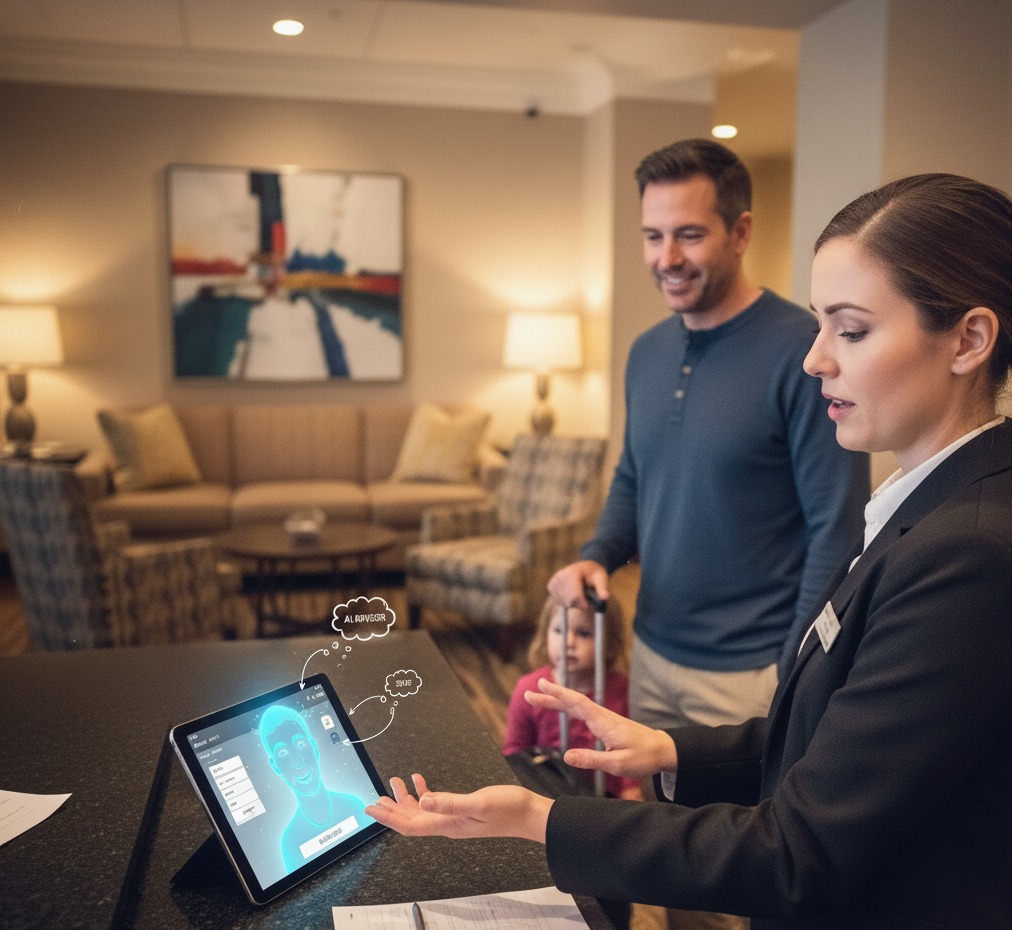
After AI: AI-powered e-learning delivers personalised training paths for each front desk team member. New starters whose AI assessment reveals strong customer service skills but limited hotel-specific knowledge receive focused product and systems training. AI roleplay simulations allow reception staff to practise check-in upselling conversations — room upgrades, late check-out, restaurant reservations, spa packages — with immediate coaching feedback on their technique.
Food and Beverage Service and Sales
Before AI: F&B training covers menu knowledge, service procedures, and allergen awareness through briefings and shift training. Upselling is encouraged but the techniques are not systematically developed. New menu items are communicated through pre-service briefings that some staff miss.
After AI: AI delivers menu-specific training tailored to each outlet and role. A sommelier receives advanced wine pairing training while a breakfast server focuses on buffet management and guest interaction. Roleplay simulations practise upselling conversations — recommending wine pairings, suggesting premium dishes, promoting special dining experiences. AI ensures all staff are trained on new menu items and allergen requirements before their next shift, with assessments confirming understanding.
Housekeeping Standards
Before AI: Housekeeping training is delivered through demonstration and supervision during initial shifts. Standards are documented in manuals. Ongoing quality depends on supervisory checks that may or may not happen consistently.
After AI: AI delivers visual, interactive training on room preparation standards, adapted to room type and brand tier. Micro-learning modules refresh standards periodically, with adaptive assessments confirming adherence. When standards change — new amenity suppliers, updated sustainability practices, renovation-related changes — AI delivers targeted training to relevant staff automatically.
Trade and Group Sales
Before AI: Hotel sales teams targeting trade partners, corporate clients, and event bookers receive periodic sales training. Product knowledge is developed through experience rather than structured programmes. Objection handling and negotiation skills are rarely practised formally.
After AI: AI roleplay simulates realistic sales scenarios — a corporate RFP negotiation, a wedding enquiry with budget constraints, a tour operator rate negotiation. Sales coaching analyses approach and provides specific improvement recommendations. Performance tracking correlates training engagement with revenue outcomes.
AI Training Use Cases
| Use Case | AI Capability | Business Outcome |
|---|---|---|
| New starter onboarding | Adaptive assessment creates personalised induction paths by role | 30-50% reduction in time to competence across all departments |
| Check-in upselling | AI roleplay practises upgrade and ancillary selling conversations | 15-25% increase in front desk upselling revenue |
| F&B menu knowledge | AI-generated training from menu data with allergen and dietary focus | Reduced allergen incidents; improved guest dining experience |
| Brand standard adherence | Continuous micro-assessments with adaptive refresher training | Higher mystery guest scores and more consistent brand delivery |
| Seasonal staff induction | Compressed, personalised onboarding that focuses on essential competencies | Better seasonal staff performance without extended training periods |
| Complaint handling | AI simulates guest complaint scenarios across departments | Improved service recovery; higher guest satisfaction after incidents |
| Revenue management awareness | Training on pricing strategy and yield concepts for front-line staff | Better rate integrity and reduced unauthorised discounting |
| Multi-property consistency | Centralised AI training with property-specific customisation | Consistent guest experience across the portfolio |
Implementation Guide
Phase 1: Pilot (Weeks 1-4)
Objective: Prove the concept with one property and one or two departments.
- Select a representative property — ideally mid-size with reasonable turnover
- Focus on front office and one other department (F&B or housekeeping)
- Configure the TravAI platform with your brand standards, product details, and service protocols
- Establish baselines: onboarding time, guest satisfaction scores, upselling revenue, mystery guest results
- Run AI training alongside existing induction for direct comparison
- Gather staff and manager feedback weekly
Phase 2: Rollout (Weeks 5-12)
Objective: Expand to all departments within the pilot property, then to additional properties.
- Extend AI training to all departments: front office, F&B, housekeeping, sales, spa, events
- Roll out to additional properties in the portfolio
- Add sales coaching for commercial teams and roleplay for all guest-facing roles
- Integrate with PMS and HR systems for automated onboarding triggers
- Train department heads and GMs to use performance dashboards
- Reduce costs by replacing generic classroom sessions with targeted AI-powered development
Phase 3: Optimisation (Months 4-6+)
Objective: Maximise ROI through data-driven refinement.
- Analyse correlation between training engagement and guest satisfaction, revenue, and retention metrics
- Use AI data to inform recruitment — what knowledge and skills predict success in each role?
- Expand to training at scale across all properties, including franchise and managed properties
- Integrate training data with revenue management for precise ROI measurement
- Continuously refine content based on guest feedback patterns and operational data
ROI Analysis
| Investment Area | Return Metrics | Expected Timeline |
|---|---|---|
| Onboarding acceleration | 30-50% reduction in time to competence; reduced early-stage attrition | Months 2-3 |
| Upselling training | 15-25% increase in front desk and F&B upselling revenue | Months 3-6 |
| Guest satisfaction | 5-15% improvement in guest review scores through more consistent service | Months 3-6 |
| Training cost reduction | 30-45% reduction in classroom training hours; trainer time redirected to high-value coaching | Months 2-4 |
| Brand standard compliance | 10-20% improvement in mystery guest audit scores | Months 3-6 |
| Staff retention | 15-20% improvement in first-year retention through better development support | Months 6-12 |
| Seasonal staff productivity | Seasonal staff reach 80% of permanent staff productivity levels within 2 weeks (vs 4-6 weeks traditionally) | Months 2-3 |
Source: Deloitte — Hospitality Industry Outlook; McKinsey — Travel, Logistics and Infrastructure
Integration with Existing Systems
Property management systems (PMS): AI training integrates with your PMS to automate training triggers — new starters are enrolled automatically, and training scenarios reflect real room types, rates, and availability patterns. Guest history data (anonymised) can inform training scenarios to make practice relevant.
HR and workforce management: New hire onboarding workflows trigger personalised AI training paths based on role, department, and property. Completion and competency data feed back into HR systems for probation reviews and development planning.
Revenue management systems: Training data correlated with revenue data demonstrates the ROI of specific training interventions. Front desk staff whose upselling training scores improve can be tracked against their upselling revenue contribution.
Guest feedback platforms: AI identifies training opportunities from guest feedback patterns — if multiple reviews mention slow check-in at a specific property, AI targets relevant training to that property's front desk team.
Existing LMS: TravAI works alongside or replaces legacy learning management systems. See AI e-learning vs traditional LMS for detail. For a broader view of AI in hospitality beyond the front desk, see our dedicated guide.
Case Study: Scenario — Boutique Hotel Group Transforms Multi-Property Training
The situation: A UK boutique hotel group with 8 properties and 450 staff faces two critical problems. Guest review scores have declined across three properties, with recurring themes of inconsistent service and missed upselling opportunities. Staff turnover is running at 38%, meaning the group is effectively re-training a third of its workforce every year.
The AI training approach: The group implements TravAI starting with the three underperforming properties. Every team member completes an AI-powered competency assessment tailored to their role and department. The results reveal significant knowledge gaps in brand standards and product knowledge among staff with fewer than six months' tenure — the inevitable consequence of high turnover and time-pressured onboarding.
AI creates personalised development paths for each team member. Front desk staff receive roleplay simulations practising check-in conversations, room upgrade suggestions, and complaint handling. F&B staff practise menu recommendations, upselling techniques, and dietary requirement handling. All staff receive brand standard refresher micro-modules adapted to their assessed knowledge level.
GMs and department heads receive weekly performance dashboards showing team competence levels, training engagement, and areas requiring managerial coaching intervention.
The results (over 6 months):
- Guest review scores improved by an average of 0.4 points across the three pilot properties
- Front desk upselling revenue increased by 21%
- F&B covers per guest increased by 8% through improved recommendation technique
- Staff first-year retention improved from 62% to 74%, attributed in part to better onboarding and development support
- Training delivery costs reduced by 35% through replacement of generic classroom sessions
- The group rolled out AI training to all 8 properties based on pilot results
These outcomes align with research on AI-powered performance development in hospitality settings.
Getting Started Checklist
- Audit current training by department: Map all training activities, costs, and time for each department — front office, F&B, housekeeping, sales, spa, events
- Identify your biggest performance gap: Is it onboarding speed, service consistency, upselling capability, or brand standard compliance?
- Measure baselines: Guest satisfaction scores, upselling revenue, mystery guest results, staff turnover, onboarding time to competence
- Select a pilot property: Choose a property that is representative of your portfolio and has engaged leadership
- Choose pilot departments: Start with front office plus one other — F&B for revenue impact, housekeeping for operational consistency
- Gather brand and operational content: Brand standards documents, service protocols, menu details, room specifications, and rate structures
- Brief GMs and department heads: Position AI training as a tool that enhances their coaching capability and supports their teams
- Plan system integration: Identify PMS, HR, revenue management, and guest feedback systems that should connect with AI training
- Define success criteria: Set measurable targets — what improvement in guest scores, revenue, or retention would justify full rollout?
- Assign a project lead: Ideally someone with group-level authority who can coordinate across properties and departments
For more on how AI is transforming hotel operations and training, see AI in hospitality.