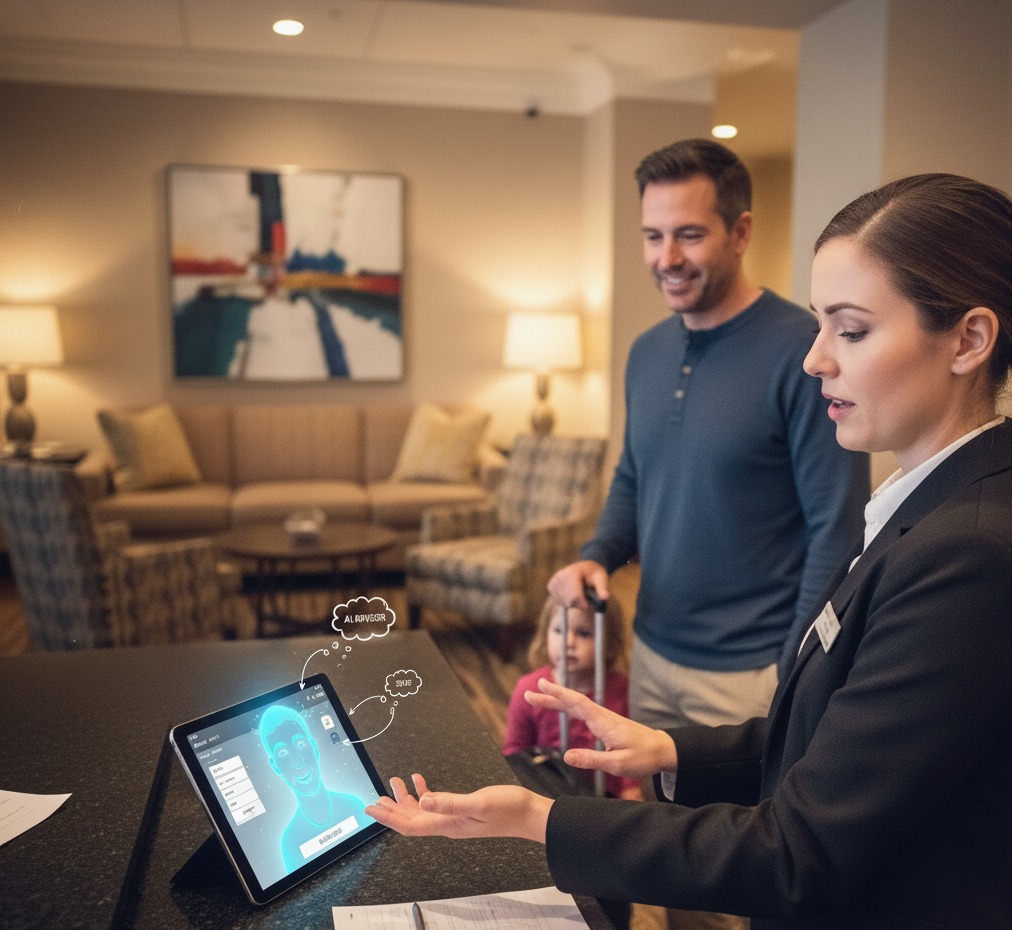
Every hotel has revenue sitting in empty upgraded rooms, unbooked spa slots, and unreserved restaurant tables. The front desk, reservations team, and F&B staff interact with every guest — making them the highest-volume sales channel the property has. Yet most hotels don't train these teams to sell.
The result: room upgrades go unoffered, spa treatments unmentioned, dining experiences unbooked. A 200-room hotel at 75% occupancy with untrained staff might generate £2-£5 per room night in upsell revenue. The same hotel with trained staff generates £12-£25 — a difference of £365,000-£1,095,000 annually.
Why Hotel Staff Don't Upsell (And How to Fix Each Reason)
Reason 1: "I don't want to be pushy"
The most common barrier. Staff equate selling with pressure, creating psychological resistance.
The fix: Reframe upselling as guest service, not sales. A front desk agent who notices it's a guest's anniversary and offers a suite upgrade isn't being pushy — they're being attentive. A server who recommends a wine pairing isn't selling — they're enhancing the meal.
Train the mindset first: "You're not trying to take money from the guest. You're offering them an opportunity to have a better experience."
AI roleplay practice builds confidence by letting staff experience dozens of positive upselling interactions in a safe environment. When the simulated guest responds enthusiastically to an upgrade offer, the psychological barrier starts dissolving.
Reason 2: "I don't know what to offer"
Staff who don't know the difference between room categories, or what makes the suite worth the upgrade premium, can't sell confidently.
The fix: Product knowledge training that goes beyond facts to selling points. Not just "the Deluxe room is 35sqm with a king bed" but "the Deluxe room has a separate seating area where you can relax while the kids are in bed — families particularly love the extra space."
| Room Category | Facts | Selling Points |
|---|---|---|
| Superior → Deluxe | Extra 10sqm, seating area | "The seating area means you have somewhere to unwind after the kids are asleep" |
| Deluxe → Suite | Separate living room, bath | "The suite has a living room for evening drinks and a deep soaking bath — perfect for decompressing" |
| Standard → Sea View | Same room, different view | "You wake up to the Mediterranean every morning — guests tell us it transforms the whole stay" |
AI-generated assessments verify that staff can articulate selling points, not just recite room specs.
Reason 3: "I don't know how to bring it up"
Even willing staff struggle with the transition from administrative check-in to selling conversation.
The fix: Teach specific moment-based techniques rather than generic scripts.
The observation technique: "I can see you're celebrating a special trip — we have a beautiful corner suite available tonight that would make it really memorable. Shall I check if we can offer a preferential upgrade rate?"
The choice technique: "I have two rooms available for you tonight: your booked Superior room on the third floor, or I can offer you a Deluxe on the top floor with a sea view for an additional £40. Which would you prefer?"
The benefit-led technique: "Since you mentioned you'll be working from the hotel tomorrow, I should mention we have a suite available with a separate workspace and complimentary high-speed internet — much more comfortable than working from a standard room."
Roleplay practice with AI coaching feedback on timing, language, and guest-reading helps staff find their natural approach within these frameworks.
Reason 4: "Nobody tracks it, so why bother?"
If upselling effort isn't measured, it isn't valued. Staff focus on what's visible and rewarded.
The fix: Track and recognise upselling performance:
- Daily upsell revenue per agent on a visible dashboard
- Monthly upsell leaderboard (with team incentive, not just individual)
- Connection between training performance and sales results
- Manager coaching conversations that include upselling technique review
The Upselling Training Programme
Module 1: Product Mastery (Week 1)
Staff can't sell what they don't know. Begin with comprehensive product knowledge training:
- Every room category: features, differences, selling points, typical guest suitability
- F&B offerings: restaurant concepts, menus, special experiences, private dining
- Spa and wellness: treatments, packages, selling points by guest type
- Experiences: local activities, transfers, excursions the hotel recommends or operates
- Packages: existing bundles and how to create bespoke combinations
AI assessment at the end of Module 1 verifies genuine knowledge: "A couple celebrating their 25th anniversary asks for your recommendation. Which room category would you suggest and why?" — not multiple choice, but open response with AI evaluation.
Module 2: Technique Training (Week 2)
With product knowledge as foundation, build selling technique:
- Guest reading: Identifying cues that signal upgrade receptivity (occasion mentions, lingering at room category descriptions, travelling with children)
- Timing: When to offer during check-in (after greeting, before room assignment — not as an afterthought)
- Language: Framing upgrades as opportunities, not costs
- Handling "no": Graceful acceptance without awkwardness
- Handling "maybe": Techniques for helping undecided guests (offering to show the room, time-limited offers)
Method: AI roleplay simulations with varied guest personas:
- The price-conscious family (offer value-adds, not upgrades)
- The celebrating couple (emotional appeal, experience framing)
- The business traveller (productivity and comfort framing)
- The indecisive guest (gentle guidance, room tour offer)
Module 3: Advanced Techniques (Week 3-4)
- Bundling: Combining room upgrade with dinner reservation and spa treatment at a package price
- Pre-arrival upselling: Email communication offering upgrades before arrival (when to send, how to frame)
- In-stay upselling: Identifying opportunities during the stay (restaurant upsells, spa treatments, late check-out, extended stay)
- Cross-departmental selling: Front desk promoting F&B, F&B promoting spa, concierge promoting experiences
Module 4: Ongoing Practice and Coaching (Continuous)
- Daily roleplay practice (5 minutes per shift)
- Weekly AI coaching review of upselling performance data
- Monthly technique refresh with new scenarios based on seasonal opportunities
- Quarterly assessment verifying product knowledge stays current
Revenue Impact by Touchpoint
| Touchpoint | Average Upsell Value | Frequency | Annual Impact (200 rooms, 75% occ.) |
|---|---|---|---|
| Room upgrade at check-in | £30-£80 per acceptance | 15-25% acceptance rate | £246,000-£1,095,000 |
| Dining recommendation | £15-£40 per table | 20-30% of guests | £164,000-£657,000 |
| Spa treatment | £50-£120 per booking | 5-10% of guests | £137,000-£657,000 |
| Late check-out | £15-£30 | 10-15% of guests | £82,000-£246,000 |
| Experience/activity | £30-£80 per booking | 3-8% of guests | £49,000-£350,000 |
These figures compound. A hotel capturing opportunities across all touchpoints with trained staff generates substantially more revenue per guest than one relying on guest-initiated purchases alone.
STR Global data confirms: hotels with structured upselling programmes achieve 8-15% higher TRevPAR (Total Revenue Per Available Room) than comparable properties without.
Common Training Mistakes
Scripting every word: Rigid scripts sound robotic. Train frameworks and principles; let staff use natural language within those structures.
Training once: Skills decay. Continuous roleplay practice and coaching maintain and improve technique over time.
Ignoring "no" handling: The fear of awkwardness after a declined offer is what stops most staff from trying. Practise graceful "no" handling specifically — "No problem at all, your Superior room is lovely. Let me get you checked in" — so it becomes natural.
Measuring only acceptance rate: Measure attempt rate too. A 50% acceptance rate on 10% of check-ins generates less revenue than a 20% acceptance rate on 80% of check-ins.
Not connecting to guest satisfaction: Upselling training must reinforce that the goal is a better guest experience. If staff feel they're being measured on revenue alone, they'll push too hard and damage satisfaction. Measure both.
Build your hotel upselling programme with TravAI →
This article is part of our Hotel Staff Training series. Related reading: