There's a gap in most travel training programmes. Agents complete product knowledge modules. They pass assessments. Their knowledge scores are high. But their selling performance doesn't improve proportionally. They know the products — but they can't sell them effectively in live customer conversations.
ATD research quantifies this: 75% of training fails to transfer to job performance. The gap between knowing and doing is the most expensive problem in training. And the solution is practice.
The Knowledge-Performance Gap
Why Knowledge Alone Doesn't Drive Sales
| What Knowledge Training Teaches | What Selling Actually Requires |
|---|---|
| Product features and benefits | Reading customer reactions and adapting in real-time |
| Pricing and availability | Navigating budget conversations without losing the sale |
| Destination information | Telling compelling stories that create desire |
| Objection handling theory | Responding naturally under pressure when objections arise |
| Upselling rationale | Timing the upgrade offer so it feels like service, not a push |
| Closing techniques | Reading buying signals and asking for the booking confidently |
An agent who scored 90% on a Maldives knowledge assessment may still struggle to sell the Maldives to a real customer. Knowledge is necessary but insufficient. The missing element is practice — the repeated application of knowledge in realistic situations until it becomes natural behaviour.
The Practice Problem
Traditional practice options are inadequate:
| Practice Method | Limitation |
|---|---|
| Practise on real customers | Risk of lost bookings; no feedback on technique |
| Manager roleplay | Manager time is scarce; uncomfortable dynamic |
| Peer roleplay | Both parties feel awkward; feedback quality varies |
| Classroom roleplay | Infrequent; social anxiety inhibits performance |
| No practice at all | Most common outcome — agents go from module to customer with no bridge |
How AI Roleplay Solves the Gap
What AI Roleplay Is
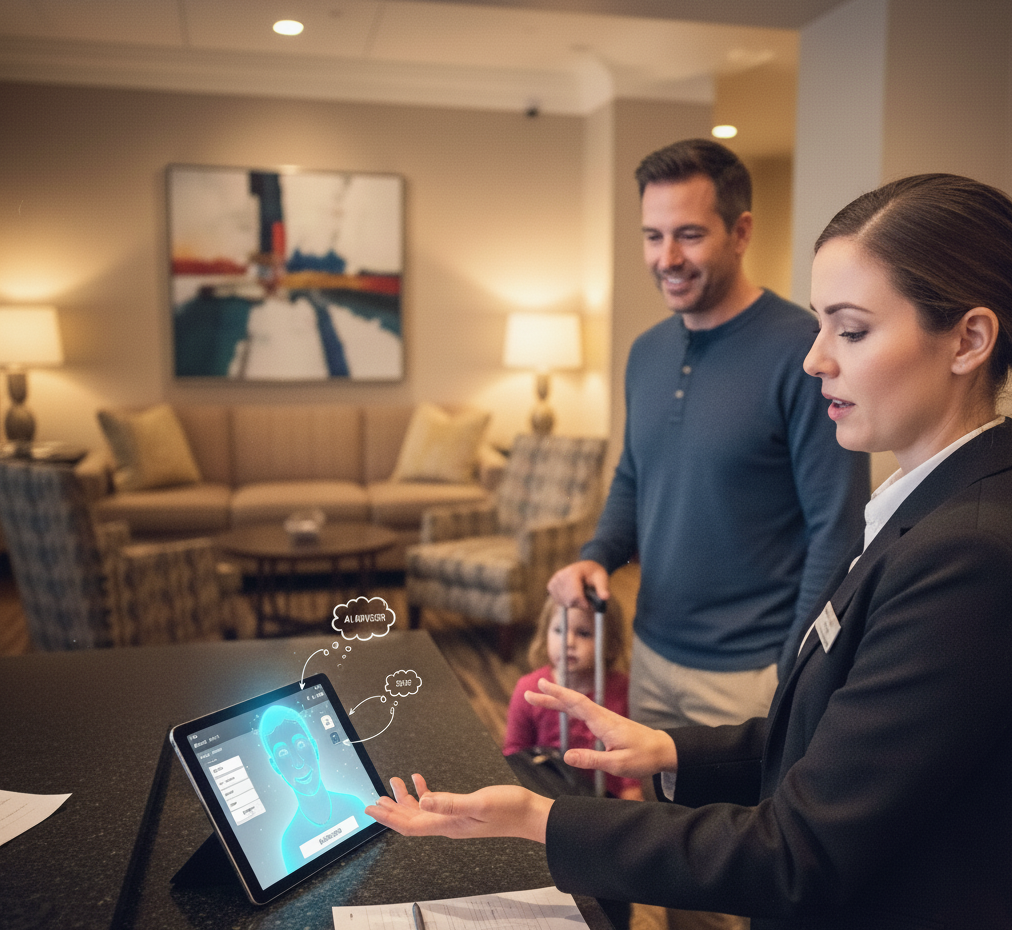
AI-powered roleplay creates simulated customer conversations where agents practise selling, handling objections, and managing complex situations with a virtual customer that responds dynamically and realistically.
The virtual customer:
- Speaks naturally (not from a decision tree or script)
- Responds to what the agent actually says
- Raises realistic objections appropriate to the scenario
- Varies behaviour across different personas
- Provides unlimited practice without fatigue or scheduling
What AI Coaching Delivers
After each roleplay session, AI coaching provides specific, actionable feedback:
Not this: "Good job! 7/10."
This: "You opened with a strong needs analysis question, which is excellent. However, when the customer mentioned their anniversary, you didn't explore what that means for their trip expectations. This was a missed opportunity to personalise your recommendation. When the customer raised the budget objection, your response focused on justifying the price rather than reframing the value. Try acknowledging their concern first, then connecting the price to the specific experiences they said they wanted. Your closing was confident but slightly premature — the customer hadn't confirmed the dates. Securing dates before asking for the booking would have felt more natural."
This level of feedback transforms practice from repetition into development.
Implementing AI Roleplay
Scenario Design
Build roleplay scenarios that match your most common and highest-value selling situations:
Priority scenarios (implement first):
| Scenario | Skills Practised | Typical Duration |
|---|---|---|
| New enquiry consultation | Needs analysis, product matching, recommendation | 5-8 minutes |
| Price objection handling | Value reframing, budget navigation, alternative options | 3-5 minutes |
| Upselling conversation | Upgrade positioning, value communication, soft close | 3-5 minutes |
| Competitor comparison | Differentiation, value proposition, confidence | 3-5 minutes |
| Complaint resolution | Empathy, problem-solving, recovery | 5-7 minutes |
Customer persona variety:
| Persona | Characteristics | What It Tests |
|---|---|---|
| Budget-conscious couple | Price-sensitive, comparison shopping | Value communication, budget navigation |
| Luxury traveller | High expectations, detail-oriented | Premium selling, attention to detail |
| Family with young children | Practical concerns, safety-focused | Needs identification, practical knowledge |
| Business traveller | Time-pressed, efficiency-focused | Concise communication, quick recommendations |
| Hesitant first-timer | Uncertain, many questions, needs reassurance | Trust-building, patience, confidence |
| Returning customer | Expectations based on previous experience | Personalisation, loyalty building |
Integration with Knowledge Training
The most effective model connects eLearning directly to roleplay:
Sequence:
- Learn: Complete interactive module on Caribbean resorts (15 minutes)
- Test: Pass knowledge assessment on Caribbean products (10 minutes)
- Practise: Complete AI roleplay — sell a Caribbean holiday to a virtual customer (5-8 minutes)
- Coach: Receive AI coaching feedback on selling technique (2 minutes)
- Refine: Repeat roleplay with adjustments based on coaching (5-8 minutes)
The roleplay step is where knowledge transforms into capability. Without it, Steps 1 and 2 produce an informed agent. With it, they produce an effective seller.
Practice Frequency
| Frequency | Benefit | Recommended For |
|---|---|---|
| Daily (5 minutes) | Rapid skill development, habit formation | New starters in first 30 days |
| 2-3 times per week | Steady improvement, manageable time investment | Ongoing development for all agents |
| Weekly (10-15 minutes) | Maintenance and new scenario practice | Experienced agents |
| After each new product module | Apply new knowledge immediately | All agents completing training |
Progressive Difficulty
AI roleplay should become more challenging as agents develop:
| Level | Virtual Customer Behaviour | Agent Skill Tested |
|---|---|---|
| Beginner | Clear needs, straightforward conversation, mild objections | Basic consultation and recommendation |
| Intermediate | Mixed signals, budget sensitivity, competitive comparisons | Needs analysis depth, value communication |
| Advanced | Complex needs, strong objections, emotional factors, difficult decisions | Advanced selling technique, empathy, creativity |
| Expert | Highly specific requirements, multiple objections, time pressure | Expert-level consultation, confident closing |
AI platforms can automatically adjust difficulty based on agent performance — ensuring practice remains challenging without becoming discouraging.
Measuring Roleplay Impact
Direct Metrics
| Metric | Source | What It Shows |
|---|---|---|
| Roleplay completion frequency | Platform analytics | Practice volume |
| AI coaching scores over time | Coaching evaluations | Skill development trajectory |
| Scenario pass rates | Roleplay assessments | Current capability level |
| Areas of consistent weakness | Coaching pattern analysis | Targeted development needs |
| Improvement rate | Score trend analysis | Speed of skill development |
Business Impact Metrics
| Metric | Measurement Approach | Expected Impact |
|---|---|---|
| Conversion rate | Compare agents with regular roleplay vs those without | +25-40% improvement |
| Average booking value | Track upselling success pre/post roleplay implementation | +15-25% increase |
| Customer satisfaction | Post-trip survey scores | +10-15% improvement |
| Agent confidence | Self-assessment survey | +30-50% improvement |
| Call quality (if monitored) | Manager evaluation of live calls | Measurable improvement in technique |
The ROI Case
For a 50-agent agency:
| Investment | Amount |
|---|---|
| AI roleplay platform capability | Included in platform subscription |
| Agent time (30 minutes/week average) | £1,250/week (50 × 25 minutes × £1/minute) |
| Annual practice investment | £65,000 |
| Return | Amount |
|---|---|
| Conversion rate improvement (25% uplift on £2M annual bookings) | £500,000 |
| Average booking value increase (15% on converted bookings) | £225,000 |
| Annual revenue impact | £725,000 |
| ROI | 1,015% |
The 30-minute weekly practice investment produces returns that dwarf the cost. More importantly, these returns compound: agents who practise continuously improve continuously, creating a performance flywheel.
Making Practice Stick
Build It Into the Routine
- Pre-shift practice: 5-minute roleplay before the selling day starts
- Post-module practice: Complete a roleplay immediately after every product knowledge module
- Weekly practice slot: Dedicated time in the weekly schedule (not optional)
- Gamified competition: Weekly roleplay leaderboard creating positive peer pressure
Manager Enablement
Managers should use roleplay data in coaching conversations:
"I noticed your AI coaching flagged that you tend to present price before establishing value. Let's work on that — the coaching suggested leading with the experience before mentioning cost. Try that approach in your next three roleplay sessions and let's review how it feels."
This connects AI coaching to human coaching, creating a development loop that accelerates improvement.
The gap between eLearning and real-world selling is the gap between knowing and doing. AI roleplay closes it — providing the practice, feedback, and repetition that transforms knowledgeable agents into confident, effective sellers.
Add AI roleplay to your training programme →
This article is part of our eLearning & Interactive Content series. Related reading: