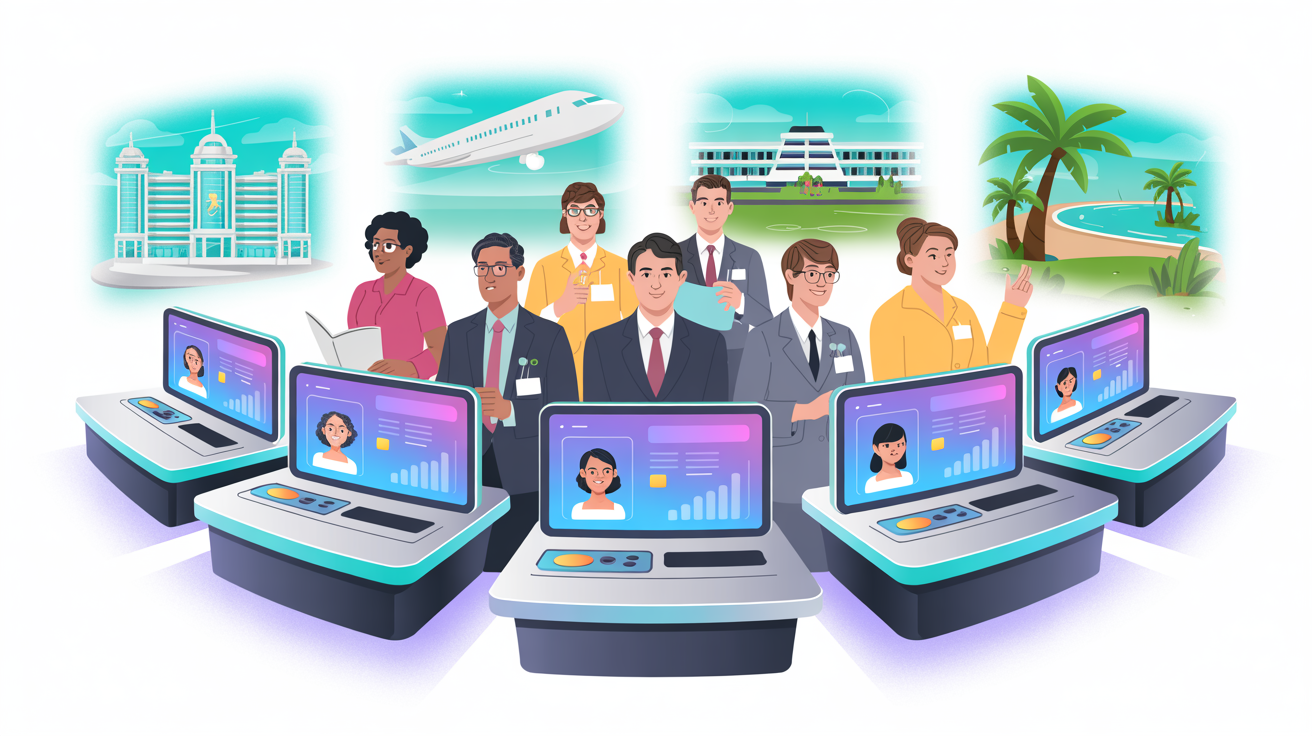
Every travel agent who knows your destination well is a sales channel. Every one who doesn't is a missed opportunity. When a customer asks "Where should I go for a walking holiday?" or "What's good for a family beach break?", the destinations that come to mind — and that the agent can sell with confidence — win the booking.
Trade enablement is one of the highest-ROI activities a DMO can invest in. The challenge: there are thousands of travel agents across the UK alone, and traditional enablement methods (FAM trips, trade shows, printed brochures) reach a fraction of them.
AI-powered training platforms transform DMO trade engagement from a high-cost, low-reach activity into a scalable, measurable channel.
Why Trade Training Matters for DMOs
The Agent Influence Factor
ABTA consumer research shows that 41% of UK holiday bookings involve a travel agent at some point in the decision process — either as the booking channel or as a source of advice and validation.
When agents recommend your destination, you gain:
- Credibility: Agent recommendations carry more weight than advertising
- Reach: Access to customers you can't reach through direct marketing
- Conversion: Agent-assisted bookings have 60-70% higher conversion rates than online-only research
- Value: Agent-booked trips have 20-30% higher average values (agents sell more experiences, upgrades, and add-ons)
The Knowledge Gap
The problem: most agents have limited destination knowledge beyond the 10-15 destinations they've personally visited or sell most frequently. A UK travel agent may be expected to advise on 200+ destinations worldwide. Deep knowledge of any single destination is rare.
| Agent Knowledge Level | % of Agents | Selling Behaviour |
|---|---|---|
| Expert (visited, trained, sells regularly) | 5-10% | Actively recommends; creates bespoke itineraries |
| Familiar (some training, general awareness) | 15-25% | Recommends when asked; sells standard packages |
| Basic (name recognition only) | 30-40% | Only sells when customer specifically requests |
| Unaware (doesn't know the destination) | 25-40% | Never recommends; may redirect to alternatives |
Moving agents from "basic" to "familiar" or from "familiar" to "expert" through training directly increases the number of sales channels for your destination.
The AI-Powered Trade Training Model
Building the Training Programme
Step 1: Define what agents need to know
Create a knowledge framework covering:
| Knowledge Area | Content | Why It Matters |
|---|---|---|
| Destination overview | Geography, climate, access, character | Agents need the basics to start conversations |
| Key selling points | What makes this destination special vs. competitors | Differentiation drives recommendations |
| Target customer matching | Which traveller types suit this destination | Agents match destinations to customer profiles |
| Product knowledge | Accommodation, attractions, experiences, dining | Agents need specifics to build itineraries |
| Practical information | Flights, transfers, visas, currency, health | Agents need logistics to complete bookings |
| Seasonal guidance | Best times to visit, seasonal experiences | Agents recommend based on timing |
| Objection handling | Common concerns and how to address them | Overcomes barriers to booking |
| Booking mechanics | How to book, who to contact, trade rates | Removes friction from the sales process |
Step 2: Create AI-powered training modules
AI training platforms generate interactive destination training from your content:
- Interactive modules covering each knowledge area (not click-through slides — conversational, adaptive content)
- Roleplay scenarios: Simulated customer conversations where agents practise selling your destination
- "A couple wants a romantic break in May — recommend and sell your destination"
- "A family asks about activities for children aged 8-12"
- "A customer says it's too expensive compared to [competitor destination]"
- Assessments: Knowledge verification confirming agents genuinely know the destination, not just completed the module
- Certification: Agents who pass become certified destination specialists
Step 3: Deploy at scale
Traditional trade training reaches dozens. AI-powered training reaches thousands:
| Method | Reach | Cost Per Agent | Knowledge Depth | Measurement |
|---|---|---|---|---|
| FAM trip | 8-15 per trip | £1,000-£3,000 | Very deep (experiential) | Anecdotal |
| Trade show | 100-200 contacts | £50-£100 | Shallow (brochure and conversation) | Poor |
| Webinar | 50-200 attendees | £5-£15 | Moderate (passive) | Basic |
| AI training | Unlimited | £2-£10 | Deep (adaptive, assessed) | Comprehensive |
The economics are compelling: a FAM trip for 12 agents costs £12,000-£36,000. That budget funds AI training for 1,200-18,000 agents.
Step 4: Maintain and update
Destination content changes — new hotels open, attractions launch, flight routes start. AI platforms enable rapid content updates that reach all trained agents immediately:
- Seasonal updates (what's new this summer, winter programme launch)
- New product alerts (new hotel, new experience, new route)
- Event promotion (festivals, sporting events, cultural programme)
- Market intelligence (trends, deals, promotional periods)
The Specialist Programme
Creating Destination Specialists
Destination specialist programmes go beyond basic training to create expert advocates:
Programme structure:
| Level | Requirements | Benefits | Recognition |
|---|---|---|---|
| Trained | Complete core destination modules | Access to trade rates and content | Certificate |
| Specialist | Pass advanced assessment + sell 5+ bookings | FAM trip priority, co-marketing opportunities | Badge for website/email |
| Expert | Annual refresher + 20+ bookings + customer satisfaction | VIP FAM experiences, advisory board membership | Featured partner status |
Why tiering works:
- Creates aspiration (agents want to progress)
- Rewards active sellers (not just course completers)
- Identifies your most valuable trade partners
- Provides a framework for ongoing engagement
Integrating FAM Trips with AI Training
FAM trips shouldn't be standalone events — they should be the experiential layer on top of knowledge training:
Before the FAM: Agents complete AI training modules covering destination knowledge. They arrive informed, with a framework for what they're experiencing.
During the FAM: Experiences are designed to reinforce and deepen knowledge gained in training. Agents practice selling conversations about what they've experienced.
After the FAM: AI platform delivers follow-up modules, maintains knowledge through spaced repetition, and provides ongoing updates. The FAM experience doesn't fade — it's continuously reinforced.
This integrated approach multiplies FAM ROI. Research on learning retention shows that experiential learning combined with structured reinforcement achieves 80-90% retention versus 20-30% for experience alone.
Measuring Trade Training Impact
Agent-Level Metrics
| Metric | Measurement | Target |
|---|---|---|
| Training completion rate | Platform analytics | >60% of enrolled agents |
| Assessment pass rate | AI assessment | >70% |
| Certification rate | Programme tracking | >40% of completers |
| Post-training booking volume | Partner reporting / CRM | +30% within 6 months |
| Agent satisfaction with training | Post-training survey | >4/5 |
DMO-Level Metrics
| Metric | Measurement | Target |
|---|---|---|
| Total agents trained | Platform data | Growth quarter-on-quarter |
| Trade channel bookings | Partner reporting | +20% year-on-year |
| Trade channel revenue | Financial reporting | +25% year-on-year |
| Cost per trained agent | Budget / agents trained | <£10 via AI platform |
| Trade channel ROI | Revenue attributed / investment | >500% |
Connecting Training to Bookings
The most powerful measurement connects training directly to revenue:
- Track trained agents by ID (agent codes, ABTA numbers, company identifiers)
- Match against booking data from accommodation partners, tour operators, and booking systems
- Compare: booking volume from trained agents vs. untrained agents in the same period
- Calculate: incremental bookings attributable to training
When you can demonstrate that trained agents book 40% more holidays to your destination than untrained agents, the investment case for AI-powered trade training is self-evident.
Content That Agents Actually Use
Beyond training modules, provide agents with selling tools:
- Destination selling guides: One-page summaries with key selling points, target customer profiles, and sample itineraries
- Social media content packs: Ready-to-share images and captions agents can post to their followers
- Objection-handling scripts: "It's too far" / "It's too expensive" / "I've never heard of it" — with confident responses
- Sample itineraries: Pre-built trip suggestions by traveller type (couples, families, groups, luxury, adventure)
- Customer-facing flyers: PDF and digital materials agents can share with their customers
AI generates all of this from your destination content — creating dozens of agent-ready assets from a single briefing document.
Common Mistakes
Training without measurement. If you don't track which agents are trained and whether they sell more, you can't prove ROI or optimise the programme.
One-and-done training. A single module completed in 2023 doesn't influence selling behaviour in 2026. Ongoing engagement through updates, refreshers, and specialist programme progression keeps your destination top-of-mind.
Ignoring homeworkers and independents. High-street chains are obvious targets, but homeworkers, consortia members, and independent agents often have deeper customer relationships. AI training reaches them as easily as it reaches large agency groups.
Competing on content volume, not quality. Agents are bombarded with destination training. Yours needs to be genuinely engaging, relevant, and useful — not just another click-through module. AI roleplay and adaptive content differentiate your training from the forgettable.
Scale your trade engagement with TravAI →
This article is part of our DMO Marketing series. Related reading: