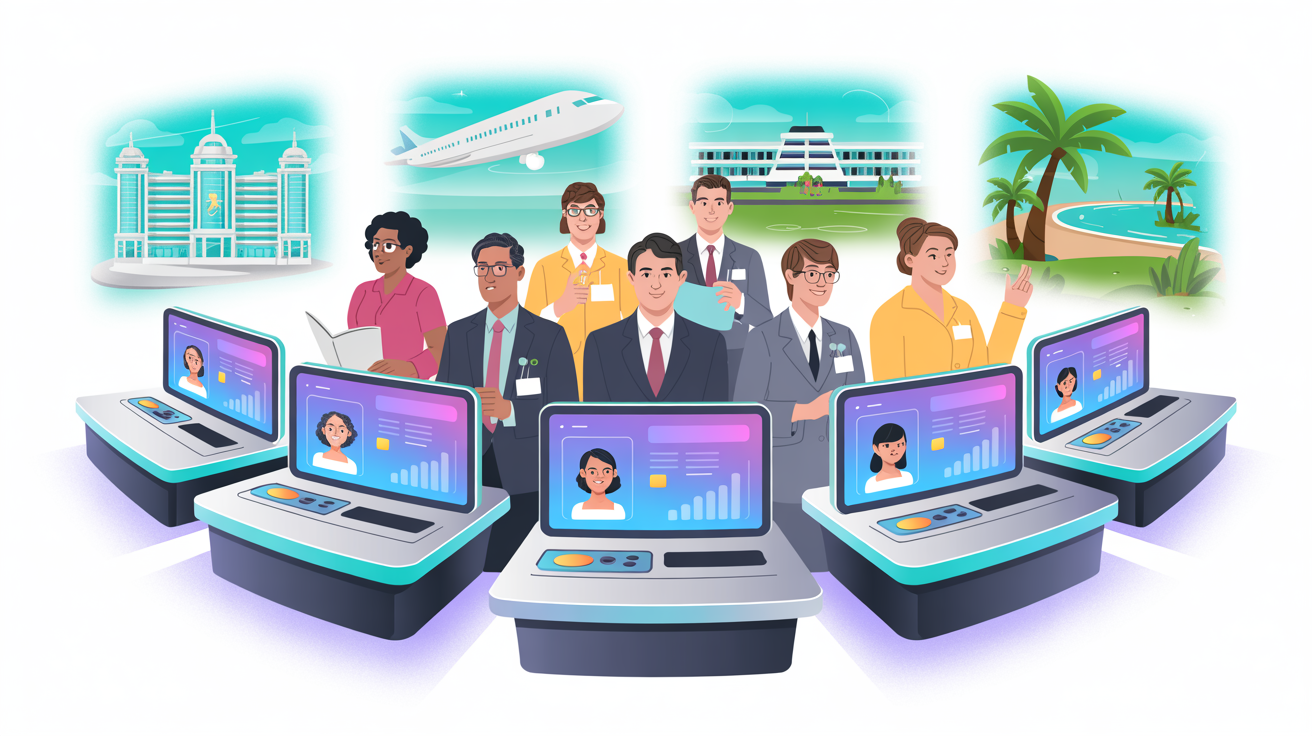
AI isn't coming to the travel industry — it's already here. The question isn't whether your business will use AI, but whether you'll adopt it strategically or be forced into reactive catch-up as competitors pull ahead.
This guide provides a practical framework for travel business leaders who want to move beyond the hype and implement AI in ways that deliver measurable commercial results.
The Current State of AI in Travel
Where the Industry Stands
The World Travel & Tourism Council identifies AI as the single most impactful technology trend affecting travel businesses in 2026. But adoption remains uneven:
| Adoption Level | % of Travel Businesses | Characteristics |
|---|---|---|
| Advanced | 8-12% | AI integrated across multiple functions; measurable ROI |
| Active | 15-20% | Using AI in 1-2 areas; experimenting with more |
| Exploring | 25-30% | Researching AI; pilot projects planned |
| Watching | 20-25% | Aware of AI; no concrete plans |
| Unaware | 15-20% | Limited understanding of AI applications |
The gap between "advanced" and "watching" widens every quarter. Early adopters compound their advantage through better data, more experienced teams, and refined processes.
Why Travel Is Ripe for AI
Several characteristics make travel businesses particularly well-suited to AI adoption:
| Travel Industry Characteristic | AI Application |
|---|---|
| Information-intensive products | AI training creates comprehensive product knowledge at scale |
| Distributed sales networks | AI enables consistent enablement across geography |
| Complex customer matching | AI improves recommendation accuracy |
| High-value transactions | Even small conversion improvements generate significant revenue |
| Seasonal demand patterns | AI optimises pricing, staffing, and marketing timing |
| Multi-language markets | AI translation removes language barriers |
The AI Readiness Assessment
Before implementing AI, assess your current position across five dimensions:
1. Data Readiness
| Question | Score 1-5 |
|---|---|
| Do you have centralised customer/booking data? | |
| Is your product information structured and up to date? | |
| Can you connect training/marketing activity to booking outcomes? | |
| Do you have clean, consistent data across systems? | |
| Can you access historical performance data for analysis? |
Score 5-10: Significant data work needed before AI implementation. Score 11-18: Foundation exists; focused improvement needed. Score 19-25: Data-ready for AI adoption.
2. Process Readiness
| Question | Score 1-5 |
|---|---|
| Are your key processes documented and consistent? | |
| Do you have clear workflows for training/onboarding? | |
| Is your content creation process structured? | |
| Do you have defined sales processes your team follows? | |
| Can you measure the output of key business processes? |
3. People Readiness
| Question | Score 1-5 |
|---|---|
| Is your leadership team supportive of technology investment? | |
| Do you have someone who can champion AI adoption? | |
| Is your team open to new tools and ways of working? | |
| Do you have (or can you access) technical implementation skills? | |
| Is there willingness to invest time in learning new systems? |
4. Technology Readiness
| Question | Score 1-5 |
|---|---|
| Are your core systems (CRM, booking, website) modern and API-capable? | |
| Do you have reliable internet and device infrastructure? | |
| Can your existing systems integrate with new platforms? | |
| Do you have IT support (internal or external) for implementation? | |
| Is your technology budget flexible enough for new investment? |
5. Strategic Readiness
| Question | Score 1-5 |
|---|---|
| Have you identified specific problems AI could solve? | |
| Do you have clear KPIs that AI could improve? | |
| Is there competitive pressure driving technology adoption? | |
| Do you have budget allocated for technology investment? | |
| Is AI adoption part of your business strategy? |
Total Score Interpretation:
| Total Score | Readiness Level | Recommended Approach |
|---|---|---|
| 25-50 | Early stage | Start with education and one focused pilot |
| 51-80 | Developing | Implement in 1-2 high-impact areas |
| 81-100 | Ready | Multi-area implementation with integration |
| 101-125 | Advanced | Enterprise-wide AI transformation |
The Implementation Roadmap
Phase 1: Quick Wins (Month 1-3)
Start with AI applications that deliver fast, visible results with minimal technical complexity:
| Quick Win | Implementation Time | Expected Impact | Investment |
|---|---|---|---|
| AI-powered training | 2-4 weeks | 3-5x faster content creation | £12,000-£30,000/year |
| AI sales coaching | 1-2 weeks | 15-25% conversion improvement | Included in platform |
| AI content generation | 1 week | 80% reduction in content creation time | £500-£2,000/month |
| AI assessments | 1-2 weeks | Measurable knowledge baselines | Included in platform |
Why start here: Training and enablement are the lowest-risk, highest-impact AI applications for travel businesses. They don't require complex system integration, deliver measurable results quickly, and build organisational comfort with AI.
Phase 2: Integration (Month 4-8)
Connect AI applications to existing business systems:
| Integration | Systems Connected | Business Value |
|---|---|---|
| Training → Booking data | Training platform + booking system | Prove training ROI; optimise content |
| AI coaching → CRM | Coaching platform + customer records | Personalise coaching to actual customer interactions |
| Content AI → Marketing | Content tools + email/social platforms | Consistent, scaled marketing output |
| Analytics → Management | Performance dashboards + BI tools | Data-driven decisions across the business |
Phase 3: Transformation (Month 9-18)
Use AI to fundamentally improve how your business operates:
| Transformation Area | Traditional Approach | AI-Powered Approach |
|---|---|---|
| Agent onboarding | 4-8 weeks, BDM-dependent | 7-14 days, self-service |
| Product launches | Sequential (create, brief, train, launch) | Simultaneous (AI creates all materials in parallel) |
| Performance management | Quarterly reviews, lagging data | Real-time coaching, leading indicators |
| Market expansion | Hire local team, translate materials | AI translation and localisation |
| Quality assurance | Manual audits, sample-based | AI-powered continuous monitoring |
Choosing Your First AI Investment
The Impact-Effort Matrix
Plot potential AI applications on this framework to prioritise:
| Low Effort | High Effort | |
|---|---|---|
| High Impact | Do First: AI training, AI coaching, AI content creation | Plan Carefully: Dynamic pricing, predictive analytics, full CRM AI |
| Low Impact | Do When Convenient: AI email sorting, basic chatbot, automated reporting | Avoid: Custom AI model development, full process automation |
For most travel businesses, the optimal first investment is an AI training and enablement platform because it:
- Requires minimal technical integration
- Delivers measurable results within 60 days
- Benefits multiple business functions simultaneously
- Builds AI literacy across the organisation
- Creates data that informs future AI decisions
Build vs Buy Decision
| Factor | Build Custom AI | Buy AI Platform |
|---|---|---|
| Cost | £100,000-£500,000+ development | £12,000-£60,000/year subscription |
| Time to value | 6-18 months | 2-8 weeks |
| Technical requirement | Dedicated AI/ML team | Standard business users |
| Customisation | Unlimited | Platform capabilities |
| Maintenance | Ongoing development cost | Included in subscription |
| Risk | High (project failure rate) | Low (proven platforms) |
Recommendation for most travel businesses: Buy a purpose-built platform rather than building custom AI. The travel industry has specific requirements that general-purpose tools don't address, and travel-specific AI platforms incorporate industry knowledge that custom builds would need to learn from scratch.
Common AI Implementation Mistakes
Mistake 1: Starting Too Big
Problem: Attempting enterprise-wide AI transformation before proving value in a single area.
Solution: Start with one high-impact application. Prove ROI. Use success to fund expansion.
Mistake 2: Focusing on Technology, Not Outcomes
Problem: Choosing AI tools based on technical capability rather than business problem.
Solution: Define the business problem first. Then evaluate whether AI is the right solution. "We want to increase agent conversion rates by 20%" is better than "We want to implement AI."
Mistake 3: Ignoring Change Management
Problem: Implementing AI tools without preparing the team to use them.
Solution: Invest in training, communication, and support. Designate an internal champion. Celebrate early wins publicly.
Mistake 4: Expecting Instant Results
Problem: Judging AI investment after 30 days rather than allowing time for adoption and optimisation.
Solution: Set realistic timelines. AI training platforms typically show measurable impact within 60-90 days. Full transformation takes 12-18 months.
Mistake 5: Not Measuring Impact
Problem: Implementing AI without baseline metrics, making it impossible to prove value.
Solution: Measure before you implement. Track the KPIs that matter: completion rates, knowledge scores, conversion rates, booking values.
The Business Case Template
Use this framework to build your AI investment case:
Current Costs
| Cost Category | Annual Amount |
|---|---|
| Training content creation (staff time) | £_____ |
| Training delivery (workshops, roadshows) | £_____ |
| Agent/staff onboarding time | £_____ |
| Support queries (answerable by self-service) | £_____ |
| Lost revenue from untrained agents | £_____ |
| Total addressable cost | £_____ |
Projected AI Impact
| Impact Area | Conservative Estimate | Data Source |
|---|---|---|
| Training creation time reduction | 70-80% | Industry benchmarks |
| Training completion improvement | 2-3x increase | Case studies |
| Agent conversion improvement | 15-25% | AI coaching data |
| Support query reduction | 30-50% | Implementation data |
| Time to competence improvement | 50-70% | Onboarding data |
ROI Calculation
Based on industry case studies, travel businesses implementing AI enablement typically see:
- Year 1 ROI: 300-500% (including implementation costs)
- Year 2 ROI: 800-1,500% (implementation costs amortised)
- Payback period: 3-6 months
Your 90-Day Action Plan
| Week | Action | Outcome |
|---|---|---|
| 1-2 | Complete AI readiness assessment | Understand your starting position |
| 3-4 | Identify top 3 business problems AI could address | Clear priorities |
| 5-6 | Research and shortlist AI platforms | 2-3 vendors for evaluation |
| 7-8 | Run demos and pilot with preferred vendor | First-hand experience |
| 9-10 | Build business case using template above | Leadership buy-in |
| 11-12 | Implement first AI application | Quick win delivered |
The travel businesses that thrive in the AI era won't be the ones with the most technology. They'll be the ones that apply AI most effectively to the problems that matter — starting with the training, coaching, and enablement that directly drives commercial performance.
Start your AI journey with TravAI →
This article is part of our Travel Industry Trends series. Related reading: