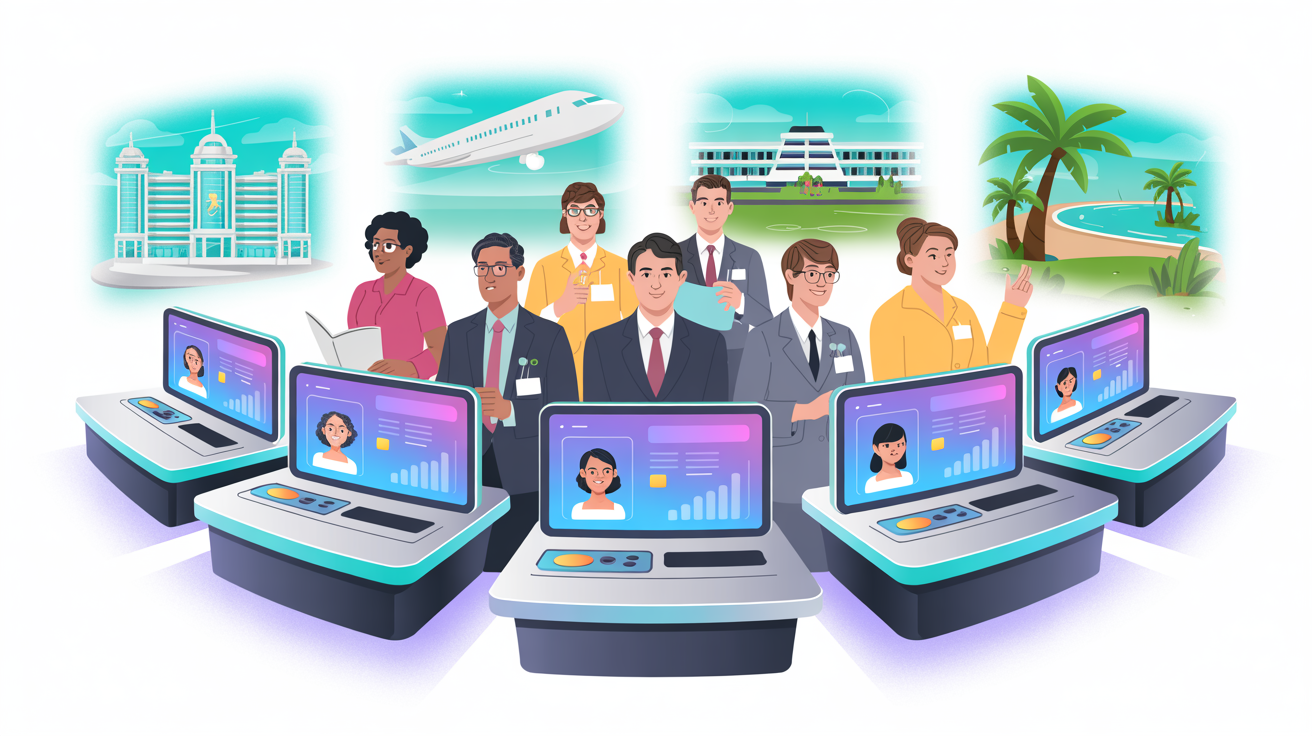
Technology in travel has shifted from competitive advantage to survival requirement. The businesses that understand and act on emerging trends early will capture disproportionate market share. Those that wait will find the gap increasingly difficult to close.
Here are the 15 technology trends that will most significantly impact travel businesses between now and 2030, ranked by likely impact and adoption speed.
Tier 1: Transforming Now (2026-2027)
1. AI-Powered Training and Enablement
Impact: Very High | Adoption: Accelerating rapidly
AI training platforms are replacing traditional eLearning across the travel industry. The shift is driven by economics: AI creates interactive training content in hours instead of weeks, at a fraction of the cost.
| Capability | Traditional | AI-Powered |
|---|---|---|
| Content creation | 40-80 hours per module | 2-4 hours per module |
| Personalisation | One-size-fits-all | Adaptive to each learner |
| Assessment | Manual question creation | AI-generated, multi-level |
| Coaching | Requires human coaches | AI coaching at scale |
| Practice | Classroom roleplay | AI-powered roleplay anytime |
Industry case studies show 20-40x ROI from AI enablement — making this the highest-return technology investment available to most travel businesses.
2. Generative AI for Content and Marketing
Impact: High | Adoption: Mainstream
Generative AI is transforming how travel businesses create marketing content, product descriptions, email campaigns, and social media. Tools like ChatGPT, Claude, and travel-specific AI platforms enable:
- Destination guides written in minutes
- Product descriptions generated from specifications
- Training content created from product information
- Email campaigns personalised at scale
- Social media content calendars automated
The risk: Generic AI content is recognisable and commoditised. The businesses that win will combine AI efficiency with authentic expertise — using AI to scale their unique knowledge rather than replace it.
3. AI Sales Coaching and Roleplay
Impact: High | Adoption: Early mainstream
AI coaching provides personalised, real-time feedback on selling technique that was previously only available from expensive human coaches. AI roleplay lets agents practise selling conversations with virtual customers that respond dynamically.
According to Gartner, organisations using AI coaching see 20-30% improvement in sales performance within the first year. For travel, where the cost of poor selling skills directly impacts revenue, this is transformational.
4. Conversational AI and Advanced Chatbots
Impact: High | Adoption: Mainstream
Beyond simple FAQ bots, conversational AI now handles complex travel queries, booking modifications, and multi-step customer interactions. The technology is reaching the point where customers can't distinguish AI from human agents for routine interactions.
Travel application: Customer-facing chatbots for booking support, pre-trip information, and post-booking upselling. Internal chatbots for agent support and self-service product queries.
5. Mobile-First Everything
Impact: High | Adoption: Already dominant
Google reports that over 70% of travel research starts on mobile. For B2B travel, agents increasingly access training, booking systems, and product information on smartphones during customer conversations.
Travel businesses still designing for desktop-first are building for yesterday's user behaviour.
Tier 2: Accelerating (2027-2028)
6. Predictive Analytics and AI-Driven Insights
Impact: High | Adoption: Growing
Machine learning analyses patterns in booking data, customer behaviour, and market trends to predict demand, identify opportunities, and optimise pricing. For travel businesses with quality data, predictive analytics transforms decision-making from reactive to proactive.
| Application | What It Predicts | Business Value |
|---|---|---|
| Demand forecasting | Booking volumes by destination/period | Optimised capacity and pricing |
| Agent performance | Which agents will book based on engagement | Targeted BDM support |
| Customer lifetime value | Revenue potential per customer | Marketing spend allocation |
| Churn prediction | Agents/customers likely to disengage | Proactive retention |
| Content effectiveness | Which training drives bookings | Content investment decisions |
7. Personalisation at Scale
Impact: High | Adoption: Growing
AI enables genuine personalisation — not just inserting a first name into an email, but tailoring the entire experience to individual preferences, behaviour, and context.
For B2B travel, personalisation means adaptive training pathways where each agent sees content relevant to their experience, their customer base, and their performance gaps. For B2C, it means marketing and booking experiences that adapt to traveller preferences.
McKinsey research shows personalisation can deliver 5-15% revenue increases and 10-30% improvement in marketing-spend efficiency.
8. API-First Integration
Impact: Medium-High | Adoption: Growing
The era of isolated systems is ending. Modern travel technology connects via APIs — linking booking systems, CRM, training platforms, marketing tools, and analytics dashboards into unified workflows.
For training and enablement, API integration means connecting learning data to booking performance, automating content updates when products change, and triggering personalised training recommendations based on agent activity.
9. Voice and Multimodal Search
Impact: Medium | Adoption: Emerging
Voice search changes how customers find travel products ("Hey Google, find me a family holiday in Greece in August"). Multimodal search combines text, images, and voice — a customer takes a photo of a beach from Instagram and searches for similar destinations.
Travel businesses need to optimise content for conversational queries and visual search to remain discoverable.
10. Augmented Reality for Product Visualisation
Impact: Medium | Adoption: Emerging
AR allows customers and agents to visualise hotel rooms, cruise cabins, attractions, and destinations before booking. While full VR remains niche, AR features accessible through smartphones are becoming practical for travel sales.
Training application: AR-enhanced product training where agents can virtually explore properties they're learning about, improving knowledge retention and selling confidence.
Tier 3: On the Horizon (2028-2030)
11. Blockchain for Travel Payments and Identity
Impact: Medium | Adoption: Early
Blockchain technology could streamline travel payments, loyalty programmes, and identity verification. Smart contracts could automate commission payments between operators and agents. Digital identity could simplify check-in processes across airlines, hotels, and border control.
Practical adoption remains limited, but pilot programmes from major airlines and hotel groups suggest broader implementation by 2028-2030.
12. Autonomous Travel Assistance
Impact: Medium | Adoption: Early
AI agents that autonomously research, compare, and book travel on behalf of customers — acting as personal travel assistants that know preferences, budget, and travel history. These go beyond chatbots to proactively suggest trips, find deals, and manage itineraries.
This technology will change the role of travel agents from researchers to curators and relationship managers, making selling skills and human expertise more important, not less.
13. Sustainable Technology and Carbon Intelligence
Impact: Growing | Adoption: Emerging
Technology that measures, reduces, and reports carbon impact across the travel supply chain. AI optimises routing, identifies sustainable alternatives, and automates ESG (Environmental, Social, Governance) reporting.
The Global Sustainable Tourism Council and increasing regulatory pressure make this a compliance requirement as much as a competitive differentiator.
14. Biometric and Frictionless Experiences
Impact: Medium | Adoption: Emerging
Facial recognition, fingerprint, and other biometric technologies are reducing friction at airports, hotels, cruise terminals, and attractions. The goal: a seamless journey from home to destination and back without paper documents or queues.
Training implication: Staff need training on new technology processes, data privacy compliance, and customer communication about biometric systems.
15. Quantum Computing for Revenue Management
Impact: Potentially High | Adoption: Experimental
Quantum computing could revolutionise revenue management by processing vastly more variables simultaneously — optimising pricing, inventory, and distribution across millions of potential scenarios.
Currently experimental, but major travel technology companies are investing in quantum research for travel applications. Practical impact is likely 2029-2030 at the earliest.
What This Means for Your Business
Priority Actions by Business Type
| Business Type | Priority Trends | First Investment |
|---|---|---|
| Tour operator | #1, #3, #6, #7 | AI training and enablement platform |
| Travel agency | #1, #3, #5, #7 | AI coaching and roleplay |
| Hotel group | #1, #4, #7, #14 | AI staff training platform |
| DMO | #1, #2, #7, #13 | AI destination training |
| Cruise line | #1, #3, #6, #10 | AI trade enablement |
| Airline | #1, #4, #9, #14 | AI trade training |
The Common Thread
Across all 15 trends, one theme dominates: AI-powered training and enablement is the foundation that enables everything else. Teams that understand new technologies sell them more effectively. Staff trained on new processes adopt them faster. Agents coached by AI sell with more confidence.
Whatever technology trends your business pursues, the ability to train, coach, and enable your people at scale determines whether those technologies deliver value or become expensive shelfware.
Future-proof your team with TravAI →
This article is part of our Travel Industry Trends series. Related reading: