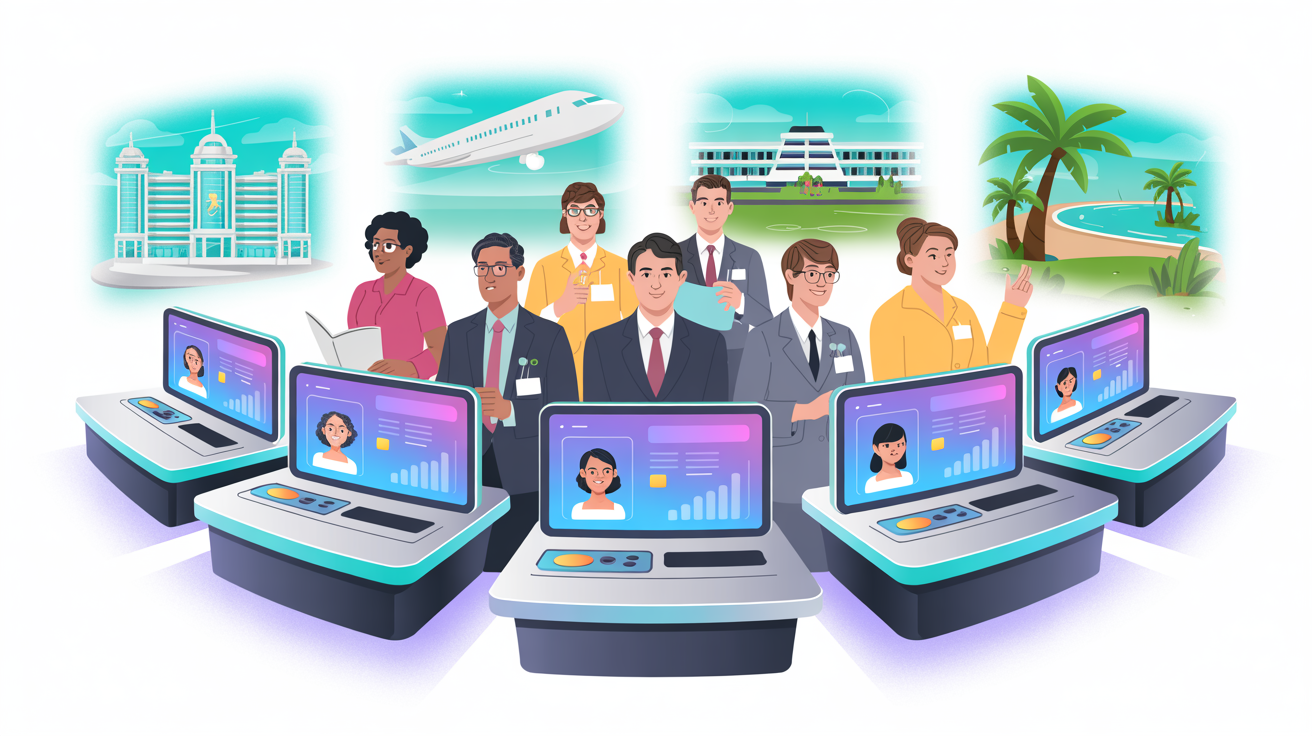
A common misconception in travel businesses: "We have a CRM, so we're covered for sales enablement." This confusion is understandable — both CRM and sales enablement platforms aim to improve sales performance. But they address fundamentally different parts of the problem, and having one without the other leaves a significant gap.
Think of it this way: a CRM tells you about your customers. A sales enablement platform equips your agents to serve those customers better. The CRM answers "who is this customer and what have they done with us before?" The enablement platform answers "does this agent have the knowledge and skills to convert this customer?"
Both questions matter. Neither tool answers both.
What a CRM Does
A Customer Relationship Management system manages customer data and the sales pipeline. In a travel context, a well-implemented CRM:
- Stores customer profiles: Contact details, travel preferences, past bookings, communication history, special requirements, important dates (birthdays, anniversaries)
- Tracks the pipeline: Where each enquiry sits in the booking journey — new enquiry, quote sent, follow-up due, decision pending, booked, post-booking
- Manages communication: Logs calls, emails, and messages with each customer, ensuring nothing falls through the cracks
- Reports on sales activity: Conversion rates, pipeline value, revenue by agent, campaign attribution
- Automates workflows: Follow-up reminders, email sequences, task assignments
Established CRM options for travel include Salesforce, HubSpot, and travel-specific systems like Tourwriter and iSell.
A good CRM ensures you never lose track of a customer or forget a follow-up. It organises the administrative side of selling — the data, the process, the communication logistics.
What a CRM Cannot Do
Despite its power, a CRM cannot:
Train agents. A CRM doesn't teach an agent the difference between a balcony cabin and an ocean-view cabin on a cruise ship. It doesn't build destination knowledge, develop selling skills, or explain how to handle a price objection. The CRM assumes the agent already knows how to sell — it just gives them the data to sell to the right customer.
Develop selling skills. Needs analysis, objection handling, upselling, closing — these are skills that require training and practice to develop. A CRM shows you that an agent's conversion rate is 22%, but it can't diagnose why or help them improve.
Provide practice opportunities. An agent who needs to improve their objection handling technique can't practise within a CRM. They need roleplay simulations with feedback — which is a sales enablement function.
Coach performance. A CRM reports what happened (the booking was made or lost). A sales enablement platform helps understand why and provides targeted coaching to improve future outcomes.
Manage product knowledge. A CRM tracks customer data, not product data. It doesn't store the key selling points of Hotel X, the comparison between two similar cruise itineraries, or the seasonal travel advice for a destination.
What a Sales Enablement Platform Does
A sales enablement platform equips agents with the knowledge, skills, and support they need to sell effectively. In travel, TravAI's platform provides:
- Interactive product training: Adaptive learning modules that build destination, supplier, and product knowledge
- Sales roleplay: Simulated customer conversations where agents practise selling skills
- AI coaching: Immediate, specific feedback on selling technique after practice sessions
- Assessments: Knowledge verification that identifies gaps and tracks improvement
- Performance analytics: Data connecting training engagement with sales outcomes
A good enablement platform ensures agents are capable of having high-quality customer conversations. It addresses the human performance side of selling — the knowledge, skills, and confidence that determine whether a customer conversation results in a booking.
What a Sales Enablement Platform Cannot Do
An enablement platform cannot:
Store customer data. It doesn't know who your customers are, what they've booked before, or when their next anniversary is. That's CRM territory.
Manage the sales pipeline. It doesn't track which enquiries are pending, which quotes have been sent, or which follow-ups are overdue.
Automate customer communication. It doesn't send follow-up emails, schedule calls, or manage multi-channel customer interactions.
Report on pipeline metrics. Revenue forecasting, campaign attribution, and sales cycle analysis are CRM functions.
The Integration Model: Better Together
When CRM and enablement platforms work together, the combination is more powerful than either alone:
Data Flow 1: CRM Informs Training
CRM data reveals what agents are selling (and not selling). If the CRM shows that Agent X converts cruise enquiries at 15% but beach holiday enquiries at 35%, the enablement platform can automatically assign cruise product training to address the knowledge gap.
If the CRM shows that excursion attachment rates are low across the team, that signals a need for cross-selling training.
Data Flow 2: Training Informs Coaching
Assessment data from the enablement platform tells managers which agents know the product and which don't. Managers can cross-reference this with CRM conversion data:
- High knowledge + low conversion: The agent knows the product but lacks selling skills → needs roleplay practice and sales coaching
- Low knowledge + low conversion: The agent doesn't know the product well enough → needs product training first
- High knowledge + high conversion: The agent is performing well → consider as a mentor or specialist
- Low knowledge + high conversion: Rare but possible — natural sales talent compensating for knowledge gaps → product training would unlock even higher performance
Data Flow 3: Enablement Proves ROI
By connecting training completion data (from the enablement platform) with booking data (from the CRM), you can calculate the ROI of training investments. This is the single most valuable integration for justifying enablement budgets.
Example query: "Show me the average booking value for agents who completed the Mediterranean training programme versus those who didn't, for Mediterranean bookings, in the last quarter."
This query requires data from both systems. The answer — say, £1,380 for trained agents versus £1,090 for untrained agents — provides irrefutable evidence of training impact.
Common Mistakes Travel Businesses Make
Mistake 1: Using the CRM as a Training Tool
Some businesses try to embed training content within their CRM — pop-up tips, product information fields, or linked documents. This is a poor substitute for purpose-built enablement because:
- CRM interfaces are designed for data entry, not learning
- Content embedded in CRM records isn't adaptive or interactive
- There's no assessment, no roleplay practice, no coaching feedback
- Agents experience it as clutter rather than learning
Mistake 2: Buying Enablement Before CRM
If you can only invest in one system initially, the CRM usually comes first. Customer data management is foundational to organised selling. However, the enablement platform should follow as quickly as budget allows — because a CRM with an undertrained team is like a sat-nav in a car with a learner driver. The directions are perfect; the driving isn't.
Mistake 3: Keeping Them in Silos
Two systems that don't share data are two silos. The integration between CRM and enablement platform is where the compound value lives. When evaluating platforms, prioritise those that offer integration capabilities — either native integrations or API connectivity.
TravAI provides API integration with major CRM platforms, enabling the data flows described above.
Mistake 4: Expecting One Tool to Do Everything
Neither a CRM nor an enablement platform is a complete solution on its own. Travel businesses that expect their CRM to handle training, or their training platform to manage customer relationships, will be disappointed by both.
Accept that selling requires multiple tools serving different functions, and focus your energy on integration and adoption rather than searching for a single tool that does everything.
Decision Framework
| Question | If Yes → CRM | If Yes → Enablement |
|---|---|---|
| Are we losing track of customer enquiries? | ✓ | |
| Are follow-ups being missed? | ✓ | |
| Do we lack visibility into the pipeline? | ✓ | |
| Are agents' product knowledge levels inconsistent? | ✓ | |
| Are conversion rates below industry benchmarks? | ✓ | |
| Do agents struggle with objections? | ✓ | |
| Is new agent onboarding too slow? | ✓ | |
| Do we need to train partner agents at scale? | ✓ | |
| Can we not prove training ROI? | ✓ |
Most travel businesses answering honestly will tick boxes in both columns — confirming the need for both systems working together.
Recommended Approach for Travel Businesses
-
If you have neither: Implement a CRM for pipeline management first, then add enablement within 3-6 months.
-
If you have CRM but not enablement: You're managing customer data but not developing agent capability. Implement an enablement platform to address the performance side of the equation.
-
If you have enablement but not CRM: You're building agent capability but losing operational efficiency. Add a CRM to capture the full value of your better-trained team.
-
If you have both but they're not integrated: Connect them. The integration delivers more value than either system independently. Start with the simplest integration: training completion data visible alongside agent performance in the CRM.
Explore how TravAI integrates with your existing tech stack →
This article is part of our Sales Enablement for Travel series. Related reading: